
Duppy
A modern twin that hovers — friction-free speed for clean, shaped surf.
The Duppy is a modern twin fin built around one feeling: speed without effort. Where a pulled-tail twin asks the wave to feed it push, the Duppy hovers — the kind of board where your turn is half-finished before you noticed you started it.
WHAT IT WANTS
Clean waist-to-head surf with shape — beach break, point, or reef with some push. Twin fins want a face to drive off; dead-flat mush won't bring the shape alive. Punches above its weight at Lowers, Salt Creek, and the smaller-day Mentawais.
SKILL LEVEL
Intermediates and advanced surfers wanting a modern twin-fin daily driver.
WHAT IT'S NOT
Not a flat-day groveler — for knee-high mush, a wider and flatter shape will paddle and plane better. Not a hollow-reef board either; when the surf gets big and heavy, a dedicated shortboard or step-up will give you more control.
BUILD DETAILS
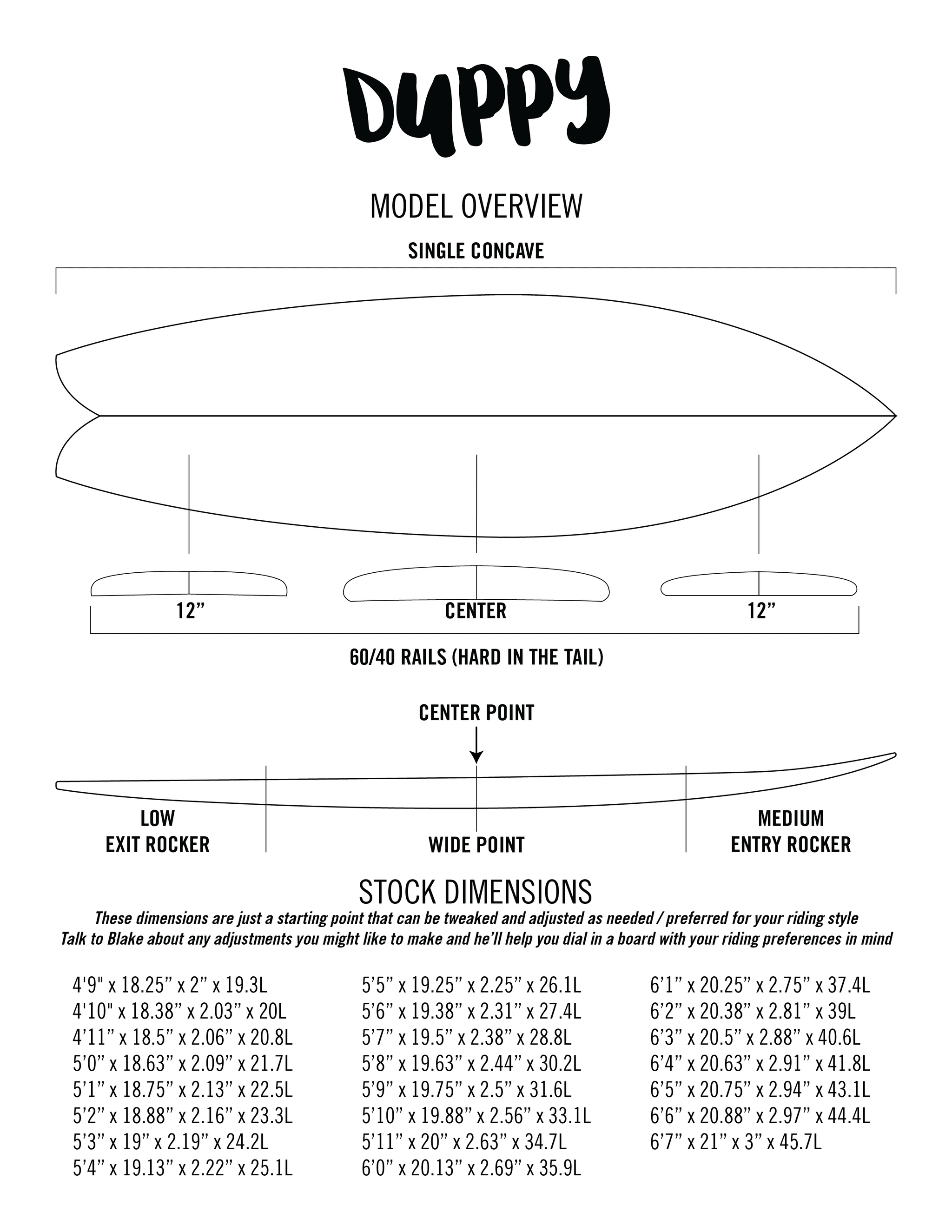
Build overview — rocker profile, rail shapes, fin positions. Hover any zone for the per-section call-outs.
THE DESIGN
A single concave runs the length of the bottom — labeled on the template — to load the lead foot and project speed through the flat middle of a wave without a thruster's bite. Medium entry rocker lets the board set its rail on a steeper takeoff without bogging; the wide point sits at center for a forgiving rail-line in the middle third; low exit rocker keeps the tail loose and fast off the back foot. Twin fin marks sit at 12" from the tail. The result surfs the shoulder cleanly — Lowers on a chest-high day, San Onofre when the point is lined up, T-Street when the tide's right — and still has shape underneath when you take it on trip, whether that's the soft mainland Mexico point days, a Baja beach break with some push, or the long-walling fun-size sessions in the Mentawais between the bigger swells.
THE RAILS
60/40 rails through the midsection give a forgiving rail-to-rail feel — exactly what a modern twin needs to skate through the soft middle of a wave without catching. Hard rails through the last 12" of the tail release water cleanly at speed, which is why the Duppy feels lively off the back foot without washing out when you commit to a turn. The rail treatment is what keeps the board driving instead of sliding.
+ Not sure which size? Calculate your volume
Volumes are starting points, not rulebooks. Conditions, stance, and style all shift the math.
STOCK DIMENSIONS
Stock dimensions are where we start. Customers tweak width, thickness, and volume to match where they surf and how they ride. Talk to Blake about any adjustments you'd like to make — he'll help you dial in a board with your riding preferences in mind.
Featured sizes cover the core-liters range (26–35L) most of our customers land in. Need a size outside the band? Expand All sizes or start a custom order for a specific dim.
| Length | Width | Thickness | Volume |
|---|---|---|---|
| 5'5" | 19.25" | 2.25" | 26.1L |
| 5'6" | 19.38" | 2.31" | 27.4L |
| 5'7" | 19.50" | 2.38" | 28.8L |
| 5'8" | 19.63" | 2.44" | 30.2L |
| 5'9" | 19.75" | 2.50" | 31.6L |
| 5'10" | 19.88" | 2.56" | 33.1L |
| 5'11" | 20.00" | 2.63" | 34.7L |
+ How to think about dims
Length. Longer = more rail line in the water (drives through a turn, holds through flat sections, paddles better). Shorter = quicker rail-to-rail, tighter in the pocket, gives up some drive.
Width. Narrower = holds a line in clean, fast waves; faster rail-to-rail. Wider = paddles better, more stable in softer surf, sits flatter on rail.
Thickness / volume. More volume = more paddle and more margin on soft days. Less volume = sensitive underfoot; rails sink cleanly; turns feel crisper. Size for the waves you actually surf, not the ones you hope to surf.
Between sizes? We usually size up in volume (not length) for softer waves, and down in volume for overhead surf with real push.
Don't see your size? Message Blake
FIN SETUP
Twin only. Futures boxes. The shape is tuned around a twin fin specifically — we don't offer quad, thruster, or trailer conversions. If you want a different fin setup, look at our other twin-fin or shortboard models.
Need help picking between rake and pivot templates? Read the fin guide, then start a conversation — Blake's happy to talk it through before you lock the build.
Recommended Fins
Twin fins live mid-rake to rake-leaning. Drive and looseness both want side fins to hold a long arc rather than pivot tight. Lean rake for fattier point break and longer carves; sit nearer mid-rake for punchier beach break. V4 Part B: 2 picks per brand spanning mid-rake (modern keel for punchier surf) and rake-leaning (classic keel for fattier walls).
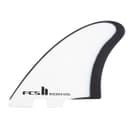
JS Modern Keel
M-L· Performance GlassModern Keel / Mid-Rake
A modern keel template tuned for the JS twin-fin shapes. Drive and hold across long-line carves with a clean release off the top — the punchier-surf pick.
Shop FCS II →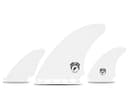
Mayhem Twinzer
L· HoneycombTwinzer / Mid-Rake
Matt Biolos's twinzer cluster — the small canard outboard adds bite and projection to the modern twin without flattening the looseness.
Shop Futures →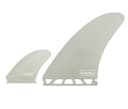
Knost Twinzer
· HoneycombClassic Keel / Rake-Leaning
Alex Knost's twinzer — fuller-foiled keels with more rake than the Mayhem. The right pick for fattier walls where you want sustained drive and a longer arc.
Shop Futures →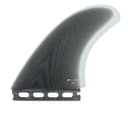
TA Twin
· Solid FiberglassModern Twin / Mid-Rake
True Ames's house twin keel — hand-foiled solid fiberglass with classic mid-rake drive. The pure-feel twin pick for retro twin shapes that want trim character and a long arc.
Shop True Ames →
Furrow Twinzer
· Solid FiberglassTwinzer / Rake-Leaning
Hand-foiled fiberglass twinzer set — main keels paired with small canards for added projection. More drive than the TA Twin; a step closer to a full keel feel for fattier surf.
Shop True Ames →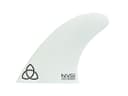
Nautilus Twin
· ApexModern Twin / Mid-Rake
NVS's flagship twin. Hand-foiled fiberglass keel set with smooth mid-rake drive — runs as a glass-on (no box) for a pure-feel build.
Shop NVS →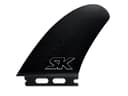
Stu Kenson Twinzer
· ApexTwinzer / Rake-Leaning
Stu Kenson's collab — hand-foiled fiberglass twinzer with rake-leaning template tuned for held-rail drive on fattier walls. The drive-focused alt to the Nautilus.
Shop NVS →Not sure which fin template is right for you? Rake, area, flex, and construction all change how a board feels.
Read the Complete Fin Guide →RAKE SPECTRUM
Where each recommended fin sits between drawn-out rake (heavier arcs, more hold) and tight pivot (vertical release, modern shortboard turning). Mid-rake (neutral) is the balanced default.
Drawn-out arcs. Power, hold, drive through long-line turns.
Balanced — drive plus pivot release. The everyday HPSB default.
Tight, vertical release. Modern shortboard pivot off the top.
 FCS IIJS Modern Keelmid-rake (neutral)
 FuturesMayhem Twinzermid-rake (neutral)
 FuturesKnost Twinzerrake-leaning
 True AmesTA Twinmid-rake (neutral)
 True AmesFurrow Twinzerrake-leaning
 NVSNautilus Twinmid-rake (neutral)
 NVSStu Kenson Twinzerrake-leaning
On a twin fin, the spectrum reads: rake = sustained drive and trim speed in fattier waves; mid-rake = the everyday pick that still releases off the top. Pivot-leaning twins exist but are rare.
WHAT TO PICK
Twin fins live mid-rake to rake-leaning. Drive and looseness both want the side fins to hold a long arc rather than pivot tight. Lean rake for fattier, drawn-out point break and longer carves; sit nearer mid-rake when you want a touch more release on punchy beach break. Per-fin picks for this model are coming — message Blake for current recommendations.
SPECS REFERENCE
Full Build Specifications
Stock dimensions, rocker, bottom contour, rail profile, fin positions, recommended fins by brand, and shaper notes for shapers and partner shops.
CONSTRUCTION & PRICING
Starting at $750 + tax
Every Duppy is built to order in San Clemente. Pick a finish tier below; customize further in the next section.
Clear Resin Sanded
4-6 weeks
Functional finish, fastest turnaround. PU blank, polyester resin, sanded off the lam.
Resin Tint Sanded
6-8 weeks
Color both sides of the board in the lam, then sand it smooth.
Tint Gloss + Polish
8-10 weeks
Top-tier finish. Resin tint plus a gloss coat polished to show-quality.
Foam + Resin options
Customize your build
AESTHETIC
STRUCTURAL
25% deposit today, balance due on completion. Timeline reflects current queue — confirmed on order.
Boards we've built
Recent customer builds — every Duppy dialed to the rider.
1122204AT (5'8 Blue Bottom + Rails)
1142204AT (5'9 Yellow Fade Rails)
1152204AT (5'9 Pink Rails)
2872201NR (5'10 Clear Simple)
3492331JNY — Mason Thurston (5’7 Teal Bottom + Rails)
3762315MH — Sean Watson (5'9 Cotton Candy Swirl)
3772315MH — Grant Lewis (5'9 Black White Swirl)
4252330AT — Grant Hansen (5'6 all black G+P)
GO DEEPER
Every construction call links to a full guide. Start with the essentials:
Board Details Checklist
Everything we need from you to begin your custom build.
Learn more →
Foam & Resin Types
Understanding the materials that make up your board's core and shell.
Learn more →
Fins — A Complete Guide
Single fins to thrusters, base systems, sizing by weight + wave, and how to pick across True Ames, NVS, Futures, and FCS.
Learn more →
Gloss + Polish vs Sanded Finish
The final touch that defines how your board looks and feels.
Learn more →
FREQUENTLY ASKED QUESTIONS
What size Duppy should I get for my weight and the waves I usually ride?
The featured 26–35L band covers the core-liters range most modern- twin riders land in. A useful starting point: if you typically ride a 28L thruster on chest-high days at Lowers or T-Street, look at the lower half of the band (5'5"–5'7" / 26.1L–28.8L). If your daily shortboard is 32L or above, the upper half (5'9"–6'0" / 31.6L–35.9L). For waves above head-high with real push, you can size down a couple of liters from your shortboard volume — the Duppy's hovering feel makes up the paddle deficit on the way in. For waist-high softer days, size up. If you're between two sizes, we usually go up in volume and not in length.
Why is the Duppy twin only? Can I get a thruster or quad version?
Twin only. The Duppy is positioned as a clean, identity-defining modern twin and the customizer config reflects that — no thruster, no quad, no five-fin convertibility. The fin marks sit at 12" from the tail; default fin box system is Futures. If you want convertibility on a twin platform, you're in different-board territory — start a conversation and we'll talk through what fits your quiver instead of forcing the Duppy to do something it isn't built for.
What waves does the Duppy work best in?
Waist-high to head-high+ clean surf with shape. The Duppy was tuned to skate through the soft middle of a wave then re-engage when the section throws — a chest-high day at Lowers, a lined-up afternoon at San Onofre, T-Street when the tide's right. On trip, it carries into the soft mainland Mexico point days, a Baja beach break with some push, or the long-walling fun-size sessions in the Mentawais between bigger swells. What it isn't: a hollow-reef gun. If you live for double-overhead Blacks or 8ft Indo, this isn't the day this board was built for.
Who is the Duppy designed for? What's the rider profile?
Best fit: an experienced surfer who already owns a high-performance shortboard and wants a second board that surfs the shoulder, not the pocket. The Duppy isn't a one-board quiver — the modern twin feel rewards a rider who knows what their shortboard does and wants a contrast for the days when the shortboard isn't the right call. Intermediate riders ready to commit to clean-wave reading and advanced surfers looking for a shoulder-surfing companion to their HPSB are both squarely in the target.
How is the Duppy built and how long does it take?
Designed by Blake in Shape3D, CNC-cut, glassed in San Clemente by Jack Sykes' team. Default glassing is 4oz S-cloth + 4oz warp deck over a 4oz S-cloth bottom — a balance of liveliness and bruise resistance that suits a board you'll surf often. Futures fin boxes by default. PU foam standard. Shaped to your specs and built to order. Turnaround times: 4–6 weeks for clear-sanded ($750), 8–10 weeks for resin-tint sanded ($900), 6–8 weeks for tint with gloss and polish ($1,100). Timeline reflects current queue and gets confirmed on order. 25% deposit holds your build slot; balance due on completion.
How does the Duppy compare to the CI Two Happy Twin or a Christenson modern twin?
Useful frame. The CI Two Happy Twin is the closest mainstream analog to the Duppy's positioning — shortboard-derived modern twin with performance rocker and a tail contour built for drive. The Christenson OP3 sits in adjacent territory but pulls the tail in more, which gives a different kind of hold-and-release feel. The Duppy's distinct contribution is the friction-free hover — the kind of board where your turn is half-finished before you noticed you started it. Where a pulled-tail twin asks the wave to feed it push, the Duppy generates speed without needing the wave to do the work. The other practical difference: the Duppy is built to your specs in San Clemente from $750 — the CI and Christenson production boards are stock-dim only.
What glassing and finish options can I order?
Three finish tiers: clear-sanded ($750), resin tint both sides sanded ($900), tint with gloss and polish ($1,100). All three include the standard 4oz S-cloth + 4oz warp deck over 4oz S-cloth bottom schedule. Add-ons available: deck patch ($30) for hard-pushing riders; white carbon tail patch ($35) recommended for the upper-band sizes (32L+); volan glass deck or bottom ($50) as a heritage option (more common on longboards but available); custom airspray ($80 single colour, $150 multi-colour or fade); resin tint abstract or swirl ($120 one side, $200 both sides); stringer alts ($40–$120 depending on choice). Read the foam + resin guide for the full foam-to-finish breakdown.
Why a single concave bottom instead of single-to-double?
The contour is single concave the whole length of the board — that's what's labeled on the template, that's what came out of the Shape3D geometry, that's what gets CNC-cut. The single concave loads the lead foot and projects speed through the flat middle of a wave without the extra release a double would add behind the fins. On a modern twin tuned for hovering through soft sections — rather than holding through hollow drives — the single concave does more of the work the rider needs done. Pair that with the medium entry rocker and low exit rocker shown on the template, and the board reads as a clean speed-and-skate twin rather than a drive-and-bite shape. If you want the drive feel of a double behind the fins, you're in thruster or quad territory rather than modern-twin territory.
Cross-reference
- Canonical context: `Boards/duppy.md` - Descriptions + competitor research: `Boards/duppy.descriptions.md` - Construction + pricing: `Boards/duppy.construction.md` - SEO + meta + JSON-LD source-of-truth: `Boards/duppy.seo.md` (extend §3.3 FAQPage stub from this file once Blake approves) - Page composition spec: `Boards/duppy.page-copy.md` - Voice rules: `Design System/Voice + Tone Rules.md`
MORE SHORTBOARDS
EXPLORE THE LINEUP
Innuendo
shortboard
Salt Burn
twin fin
Spectre
mid length
Fantasma
longboard
Scorpio
shortboard
Talisman (Mini Gun)
gun
Dutchman
glider
Rage
wake surf
2nd to None
shortboard
Suds
twin fin
Esplanade
mid length
Black Pearl
longboard
Talisman (Step Up)
shortboard
Talisman (Gun)
gun
Wake Surf #2
wake surf
Gumball
shortboard
Revenant
twin fin
Sea Bottom
shortboard
Lunada
longboard
Five Horizons
shortboard
Pin Twin
twin fin
Whip-Stitch
mid length
Big Joe
longboard
Wanted
shortboard
Duppy
twin fin
Serenata
mid length
Legacy
longboard
Gold
shortboard
Lucid
twin fin
Hiatus
mid length
Magic Carpet
longboard
Moon Shine
shortboard
Boomerang
twin fin
Apparition
shortboard
Half-Moon
twin fin
Bang!
shortboard
Aardvark
twin fin
Lasso
shortboard
Acid-Drop
twin fin
Popsicle Stick
shortboard
Big Buoy
shortboard
Pegasus
longboard
COMPLETE THE QUIVER
“Surf Everyday” means a board for every condition. Your Duppy covers waist-high to overhead— here's what rounds out the quiver.
Salt Burn
Salt Burn— Twin Fin
Sister twin fin in the Lundquist line — different rocker, foil, and outline character. See the Salt Burn page for the full breakdown.
Learn more →

Suds— Twin Fin
Sister twin fin in the Lundquist line — different rocker, foil, and outline character. See the Suds page for the full breakdown.
Learn more →

Revenant— Twin Fin
Sister twin fin in the Lundquist line — different rocker, foil, and outline character. See the Revenant page for the full breakdown.
Learn more →
Building a quiver around the Duppy? Start a conversation — we'll build the right boards for how and where you actually surf.
More boards live in the website catalog than at the shop. Visits are by appointment — text or call (949) 750-5067 to look at boards in person or start a custom build.
READY TO START?
Every Duppy is built to order in San Clemente — 4–6 weeks on clear-sanded, 6–8 weeks gloss and polish, 8–10 weeks tint-sanded. 25% deposit.
Shop: 106 W Mariposa Unit B, San Clemente, CA 92672
By appointment · 8am–8pm daily · (949) 750-5067