CONTOUR DIAGRAM
Big Buoy contour diagram coming soon. For the full hydrodynamic spec, message us and we’ll send the shaping sheet directly.
Message BlakeBig Buoy
Generous volume, modern lines — the daily driver that paddles in early without trimming the performance.
The Big Buoy is the high-volume end of the Lundquist shortboard family — designed for the surfer who wants modern performance lines but needs the paddle and forgiveness that a trimmed-out HPSB doesn't give back. Generous foam through the chest puts you over the foam ball one or two strokes earlier; a pulled-in performance outline and modern bottom contour make sure those extra liters don't dull the rail.
WHAT IT WANTS
Waist-to-overhead beach break, point, or reef with shape and push. Summer slop at San Onofre, sunrise sets at Salt Creek, clean Lowers when the south fills in. Travels well to Indo, Mexico, and Hawaii.
SKILL LEVEL
Larger riders, or any rider wanting extra paddle power and float without going up to a mid-length.
WHAT IT'S NOT
Not a flat-day groveler — for knee-high mush, a wider, flatter shape will plane better. Not a step-up either; when the surf gets to double-overhead with heavy push, a dedicated step-up will handle it.
DAILY-DRIVER POSITIONING
Tuned for the realistic SoCal week — Salt Creek on a tired Tuesday, T-Street when the wind is up, San Onofre when you just want to log waves with friends — that still has a real top-turn in it when the set wave at Lowers finally swings.
THE DESIGN
A wider chest and a flatter belly through the front foot let the Big Buoy plane early and trim through the soft middle of a wave. The exit rocker stays modern enough that you can drive it off the bottom and find the lip — this isn't a foamy mal with fin boxes glued in. The rail line carries volume forward where it helps the paddle, then pulls in toward the tail so the back foot has something to push against. Pair it with a thruster setup for control or convert to a quad on the smaller days for an extra gear of down-the-line speed.
WHERE IT EARNS ITS KEEP
Mainland Mexico beach-break trips — the Saladita-style point days, the smaller Pascuales mornings — and the in-between Indo days at Sanur or Lakey when the swell is short of firing. Anywhere the wave isn't asking you to surf at your absolute limit, the Big Buoy gives you margin without taking the modern surfing back.
THE RAILS
Performance rails — soft through the front foot for forgiveness, tucked under the back foot for clean release. Rail thickness flexes by length and rider intent.
Custom builds are tuned to your dims and surfing style. Talk to Blake about specifics.
+ Not sure which size? Calculate your volume
Volumes are starting points, not rulebooks. Conditions, stance, and style all shift the math.
STOCK DIMENSIONS
The Big Buoy's featured stock-dim band lands at 30–42L across 5'4" → 6'6" in 1" increments. That band sits where most "I want one board for everything" customers actually land — wide enough to cover a 175 lb intermediate at 32–35L all the way up to a 215 lb advanced surfer at 40L+ — without diluting the featured view with sizes nobody asks for. Decimal display by default with a fraction toggle.
Featured sizes cover the core-liters range (30–42L) most of our customers land in. Need a size outside the band? Expand All sizes or start a custom order for a specific dim.
| Length | Width | Thickness | Volume |
|---|---|---|---|
| 5'1" | 21.31" | 2.25" | 29.9L |
| 5'2" | 21.44" | 2.31" | 31.4L |
| 5'3" | 21.56" | 2.38" | 33.0L |
| 5'4" | 21.69" | 2.44" | 34.5L |
| 5'5" | 21.84" | 2.50" | 36.1L |
| 5'6" | 22.00" | 2.56" | 37.9L |
| 5'7" | 22.16" | 2.63" | 39.6L |
| 5'8" | 22.31" | 2.69" | 41.4L |
+ How to think about dims
The Big Buoy is shaped around a clear trade-off: paddle + early-entry forgiveness, in exchange for the absolute pivot-and-snap response of a trimmed-out HPSB. Sized correctly, you'll catch waves your friend on a 28-liter performance shortboard rolls through. Sized correctly, the board still draws clean lines off the bottom and finishes a turn — but it will not turn as tight or release as sharply as a true contest stick. That's the design intent, not a bug.
Sizing up too far is the most common mistake. Liters help paddle until they don't — past your weight × 0.18, the board starts to ride you instead of the other way around, and the rail-engagement window gets narrower. Stay inside the band, or sit one size below your gut feeling the first time.
Don't see your size? Message Blake
FIN SETUP
Thruster stock. Futures boxes. The thruster is the right lead config for a versatile shortboard — predictable drive off the back foot, balanced feel rail-to-rail, the most familiar setup for anyone coming from a modern shortboard. Add the 5-fin option at order time and you can run quads too on the same board.
Need help picking thruster vs quad templates? Read the fin guide, then start a conversation — Blake's happy to talk it through before you lock the build.
Recommended Fins
A modern shortboard wants fins that balance drive and release. Mid-rake (neutral) is the everyday default — runs across most clean shoulder-to-overhead conditions. Lean rake for heavier drawn-out turns; lean pivot for tight, top-to-bottom shortboard surfing.
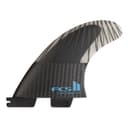
Performer
Medium· PC Carbon + AirCoreAll-Around / Mid-Rake
FCS's most versatile template. Moderate rake and balanced foil keep modern shortboards responsive rail-to-rail. The default if you're running FCS boxes.
Shop FCS II →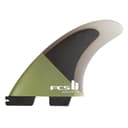
Carver
Medium· Performance CoreDrive / Rake-Leaning
More rake + larger area than the Performer. Holds drawn-out lines through head-high+ surf and rewards committed rail-to-rail carves. Reach for the Carver when the Performer feels too loose.
Shop FCS II →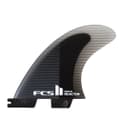
Reactor
Medium· Performance CorePivot / Top-to-Bottom
Upright template with shorter base — releases off the top vertically. The pick when you want tight, snappy shortboard surfing in punchy beach break.
Shop FCS II →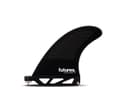
F6 Honeycomb
Medium· HoneycombAll-Around / Mid-Rake
A balanced mid-rake all-rounder — drive plus pivot release in one set. The everyday Futures pick if you want one set that covers most clean to punchy conditions.
Shop Futures →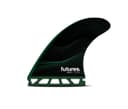
F8 Legacy Series
· HoneycombDrive / Rake-Leaning
Larger area + more rake than the F6. Sustained drive through long-line carves; the right Futures pick when you want hold over loose-tail release.
Shop Futures →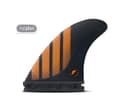
P6 Alpha
· AlphaPivot / Top-to-Bottom
Futures's P-series is their dedicated pivot template — upright leading edge, shorter base, vertical release. Pairs with shortboards built for punchy contest-style surfing.
Shop Futures →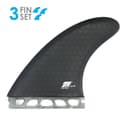
Channel Islands Tri Medium
Medium· HexcoreAll-Around / Mid-Rake
True Ames's CI-collab thruster — hand-foiled fiberglass hexcore tuned for the modern shortboard. Balanced rake plus clean foil response on Futures-compatible boxes.
Shop True Ames →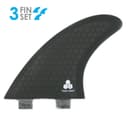
Channel Islands Tri Large
Large· HexcoreDrive / Rake-Leaning
Same CI-collab template scaled up. Larger area + more drive — the True Ames pick for shoulder-to-overhead surf where the Medium feels overwhelmed.
Shop True Ames →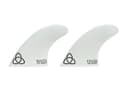
JL Thruster
Medium· Apex Glass-OnAll-Around / Mid-Rake
NVS's Apex-construction thruster — hand-foiled fiberglass with medium rake and a refined foil that generates speed without sacrificing pivot.
Shop NVS →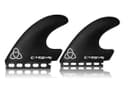
C-Drive Thruster Medium
Medium· ApexDrive / Rake-Leaning
NVS C-Drive cluster — drive-focused fiberglass hand-foil. Holds clean lines through committed turns; the NVS pick when JL feels too neutral and you want more drive off the bottom.
Shop NVS →Not sure which fin template is right for you? Rake, area, flex, and construction all change how a board feels.
Read the Complete Fin Guide →RAKE SPECTRUM
Where each recommended fin sits between drawn-out rake (heavier arcs, more hold) and tight pivot (vertical release, modern shortboard turning). Mid-rake (neutral) is the balanced default.
Drawn-out arcs. Power, hold, drive through long-line turns.
Balanced — drive plus pivot release. The everyday HPSB default.
Tight, vertical release. Modern shortboard pivot off the top.
 FCS IIPerformermid-rake (neutral)
 FCS IICarverrake-leaning
 FCS IIReactorpivot-leaning
 FuturesF6 Honeycombmid-rake (neutral)
 FuturesF8 Legacy Seriesrake-leaning
 FuturesP6 Alphapivot-leaning
 True AmesChannel Islands Tri Mediummid-rake (neutral)
 True AmesChannel Islands Tri Largerake-leaning
 NVSJL Thrustermid-rake (neutral)
 NVSC-Drive Thruster Mediumrake-leaning
On a high-performance shortboard, the spectrum reads: rake = drive priority through long-line carves; pivot = release off the top in steep pockets. Mid-rake (neutral) covers most everyday HPSB conditions.
WHAT TO PICK
Mid-rake (neutral) is the safest first pick on a high-performance shortboard — drive plus pivot release covers most clean shoulder-to-overhead conditions. Lean toward rake for heavier, drawn-out turns when the surf has push and shape; lean toward pivot for tight, top-to-bottom shortboard surfing in punchy beach break. Per-fin picks for this model are coming — message Blake for current recommendations across FCS, Futures, True Ames, and NVS.
SPECS REFERENCE
Full Build Specifications
Stock dimensions, rocker, bottom contour, rail profile, fin positions, recommended fins by brand, and shaper notes for shapers and partner shops.
CONSTRUCTION & PRICING
Starting at $750 + tax
Every Big Buoy is built to order in San Clemente. Pick a finish tier below; customize further in the next section.
Clear Resin Sanded
4-6 weeks
Functional finish, fastest turnaround. PU blank, polyester resin, sanded off the lam.
Resin Tint Sanded
6-8 weeks
Color both sides of the board in the lam, then sand it smooth.
Tint Gloss + Polish
8-10 weeks
Top-tier finish. Resin tint plus a gloss coat polished to show-quality.
Foam + Resin options
Customize your build
AESTHETIC
STRUCTURAL
25% deposit today, balance due on completion. Timeline reflects current queue — confirmed on order.
GO DEEPER
Every construction call links to a full guide. Start with the essentials:
Board Details Checklist
Everything we need from you to begin your custom build.
Learn more →
Foam & Resin Types
Understanding the materials that make up your board's core and shell.
Learn more →
Fins — A Complete Guide
Single fins to thrusters, base systems, sizing by weight + wave, and how to pick across True Ames, NVS, Futures, and FCS.
Learn more →
Gloss + Polish vs Sanded Finish
The final touch that defines how your board looks and feels.
Learn more →
FREQUENTLY ASKED QUESTIONS
What size Big Buoy should I order for my weight and the waves I usually surf?
The Big Buoy's featured volume band is proposed at 30–42L across 5'4"–6'6" in 1" increments. As a starting heuristic, multiply your body weight (in lb) by 0.18 to get the ballpark volume — that puts a 175 lb intermediate around 31–32L, a 195 lb advanced surfer around 34–35L, and a 215 lb rider around 39–40L. The Big Buoy is intentionally sized so you don't have to push past that ratio to feel the paddle benefit; the design carries the foam where it helps you and pulls in where it doesn't.
The most common sizing mistake on a high-volume shortboard is sizing UP too far. Past `weight × 0.18`, the board starts to ride you instead of the other way around — the rail-engagement window narrows and the daily-driver feel drifts toward foam-mal territory, which is not what the Big Buoy is for. If you're between sizes, sit one size below your gut feeling the first time. We'd rather you grow into the volume than out of it.
Thruster, quad, or 5-fin convertible — what should I run?
Stock setup is thruster. That's the obvious fit for the daily- driver brief: drive plus control, the genre default for a modern high-volume shortboard. If most of your sessions are in the soft- shouldered SoCal week — Salt Creek tired Tuesdays, T-Street wind days, San Onofre log-with-friends days — thruster is the right default and you should not overthink it.
Quad is the optional move for the smaller-wave end of your range. A quad on a Big Buoy frees the board up down the line and adds a gear of speed through the soft middle of a wave; it's noticeably looser than the thruster, especially on 30–34L builds. Order quad if more than half your sessions are at waist-high or smaller.
5-fin convertible installs both sets of plugs at build, so you can swap setups per session. Best for the surfer who actually wants the versatility — not just the optionality. If you'd be running thruster 99% of the time anyway, the convertible plugs are extra weight and extra holes. If you'd genuinely run quad on small days and thruster on solid days, 5-fin earns its keep. Default fin box system is Futures; FCS II and other systems available on request.
What waves does the Big Buoy actually work in?
Waist-high to chest-high+ surf is the sweet spot — the realistic SoCal week, where the wave isn't pushing as hard as you wish it would. Salt Creek on a tired Tuesday, T-Street when the wind is up, San Onofre when you just want to log waves with friends. The Big Buoy paddles and plans through the soft middle of those waves where a 28-liter HPSB rolls through unbroken sections.
It also earns its keep on a mainland Mexico beach-break trip — the Saladita-style point days, the smaller Pascuales mornings, the in- between Indo days at Sanur or Lakey when the swell is short of firing. Anywhere the wave isn't asking you to surf at your absolute limit, the Big Buoy gives you margin without taking the modern surfing back.
Where it's not the right call: solid overhead surf at Lowers with real push (size up to a step-up shape), and knee-high mush (a wider, flatter groveler will paddle and plane better than a high-volume shortboard at that scale).
Is the Big Buoy too much board for an intermediate?
No, if you can already read a wave, commit to the right rail, and draw a line off the bottom. The Big Buoy is positioned for intermediate-to-advanced surfers — the paddle and forgiveness help an intermediate catch more waves and make more sections, but the rail line and exit rocker still expect a confident lead-foot drive and an honest top-turn to finish.
If you're brand-new to a thruster or you're still riding mostly foamies and softops, this isn't the right starting board — a wider, thicker beginner-friendly groveler will get you more waves at a gentler learning curve. Start there, log a season of intermediate turns, and the Big Buoy is the natural next step when you want modern-shortboard performance without the volume penalty of a true HPSB.
How long does a Big Buoy take to build, and how does the order process work?
Each Big Buoy is built to order. Turnaround depends on the finish tier:
- Clear resin sanded ($750): 4–6 weeks
- Resin tint sanded ($900): 8–10 weeks
- Resin tint with gloss + polish ($1,100): 6–8 weeks
The board gets CNC-cut from the Shape3D file to your specified dimensions, then finished by Jack (our shaper) here in San Clemente. The CNC step is what lets us deliver a custom dim without invented turnaround penalties — the file and the cutter do the geometry; Jack does the finish work that actually makes the board feel like a Lundquist.
Order flow: pick a finish tier, customize the build (foam, stringer, deck patch, tail variant, fin system) in the configurator, and lock the order with a 25% deposit. Balance is due on completion. If you're between dim choices or want to talk through the build before committing, message Blake — that conversation happens before the deposit, not after.
How does the Big Buoy compare to a Channel Islands Average Joe?
The Average Joe is the closest peer the Big Buoy has in the mainstream shortboard catalog — both are high-volume daily-drivers with a pulled-in performance outline, both target the intermediate-to-advanced surfer who wants one board for the realistic mix of conditions, and both refuse the foamy-mal trade-off. The voice on the Average Joe page ("a step-up in volume from a high- performance shortboard while keeping the same response") is the single closest framing match for what the Big Buoy is doing.
Where they differ: a Big Buoy is CNC-cut to your specified dimensions and finished in San Clemente to your finish tier — not a stock model dim from a production-shaper template. If your CI dealer doesn't carry the Average Joe size you want, you wait for a custom order anyway. With the Big Buoy that custom order IS the default flow, and the configurator is set up so width, thickness, and volume are tunable from the start. The board itself sits in the same genre as the Average Joe, with the design choices Blake locked in during the Shape3D pass — flatter belly through the front foot, modern exit rocker, the rail line carrying volume forward where it helps the paddle and pulling in toward the tail so the back foot has something to push against.
We're not telling you to switch from a board you like. We're telling you the genre fits the same shopper either way; the build relationship is what's different.
What glassing options are available, and what should I pick?
Three finish tiers cover most decisions:
- $750 — Clear resin, sanded. Functional finish. PU blank, polyester resin, sanded off the lam — same glass schedule and foam as the higher tiers. The starter tier is a real entry point, not a stripped-down loss-leader. - $900 — Resin tint both sides, sanded. Color is in the lam, then sanded smooth. Most performance-shortboard customers order Starter or Standard. - $1,100 — Resin tint with gloss + polish. Top-tier finish. Color in the lam plus a gloss coat polished to show-quality. Worth it if you want the finish to look as deliberate as the shape.
Glass schedule on the Big Buoy is 4S+4W on the deck and 4S on the bottom as the standard build. If you're at the heavier-rider end of the size range and you want extra deck durability, ask about 6S+4W — adds weight, adds longevity. Universal upcharges (deck patch, stringer upgrades, alternate tails) attach the same way they do on any shortboard. Full add-on schedule lives in the configurator.
Can I demo a Big Buoy before I order one?
Honestly: not yet. With `in_stock_boards: []` in the polish-context JSON — meaning no Big Buoy has been built and photographed for inventory yet — there isn't a shop-pinned demo board on a rack to hand you. When the first one ships and gets ridden, that changes.
What you CAN do today:
1. Talk to Blake — message via `/contact?subject=Big%20Buoy` and walk through your weight, stance, the waves you're surfing, and the boards you've ridden recently. The conversation pre-resolves most "is this the right call" doubts. 2. Compare the genre — if you've ridden a Channel Islands Average Joe, a Pyzel Phantom XL, or a Lost Puddle Jumper HP, you already know the genre. The Big Buoy sits in that same shape space (see Q6). 3. Start at the lower end of the volume range — if you're 175 lb and you'd otherwise order a 33L, order a 31L the first time. Easy to grow into; harder to grow out of.
When demo boards exist, this answer gets updated. For now, the pre-order conversation with Blake is the demo equivalent.
§9. Conditional swap-in (when contour PNG lands)
When the Shape3D contour render is finalized for the Big Buoy and the PNG lands at `public/contour-diagrams/big-buoy.png`, replace Q5 (Build turnaround) with the design-specific question below and shift Q5 → Q6 → Q7 → Q8 → Q9 (an 8-Q list expands to 9 with the contour addition):
``` Q. Why the flatter belly through the front foot?
A. The flatter belly under the chest is what lets the Big Buoy plane early and trim through the soft middle of a wave — it spreads volume across a flatter surface so the foam-ball-to-rail handoff happens without bogging. A more curved belly through the same volume would sit deeper in the wave; a flatter belly with the same volume sits on top of it. The trade-off is less rail-engagement bite mid-wave, which is exactly the design choice the Big Buoy makes on purpose: this is a daily-driver that paddles in early, not a contest stick that pivots in the pocket. The exit rocker stays modern enough that you still get a real top-turn out of the design. ```
Until then, the 8-Q list above ships as-is.
MORE SHORTBOARDS
EXPLORE THE LINEUP
Innuendo
shortboard
Salt Burn
twin fin
Spectre
mid length
Fantasma
longboard
Scorpio
shortboard
Talisman (Mini Gun)
gun
Dutchman
glider
Rage
wake surf
2nd to None
shortboard
Suds
twin fin
Esplanade
mid length
Black Pearl
longboard
Talisman (Step Up)
shortboard
Talisman (Gun)
gun
Wake Surf #2
wake surf
Gumball
shortboard
Revenant
twin fin
Sea Bottom
shortboard
Lunada
longboard
Five Horizons
shortboard
Pin Twin
twin fin
Whip-Stitch
mid length
Big Joe
longboard
Wanted
shortboard
Duppy
twin fin
Serenata
mid length
Legacy
longboard
Gold
shortboard
Lucid
twin fin
Hiatus
mid length
Magic Carpet
longboard
Moon Shine
shortboard
Boomerang
twin fin
Apparition
shortboard
Half-Moon
twin fin
Bang!
shortboard
Aardvark
twin fin
Lasso
shortboard
Acid-Drop
twin fin
Popsicle Stick
shortboard
Big Buoy
shortboard
Pegasus
longboard
COMPLETE THE QUIVER
“Surf Everyday” means a board for every condition. Your Big Buoy covers soft waist-high to head-high— here's what rounds out the quiver.

Innuendo— Shortboard
Sister shortboard in the Lundquist line — different rocker, foil, and outline character. See the Innuendo page for the full breakdown.
Learn more →

2nd to None— Shortboard
Sister shortboard in the Lundquist line — different rocker, foil, and outline character. See the 2nd to None page for the full breakdown.
Learn more →

Gumball— Shortboard
Sister shortboard in the Lundquist line — different rocker, foil, and outline character. See the Gumball page for the full breakdown.
Learn more →
Building a quiver around the Big Buoy? Start a conversation — we'll build the right boards for how and where you actually surf.
More boards live in the website catalog than at the shop. Visits are by appointment — text or call (949) 750-5067 to look at boards in person or start a custom build.
READY TO START?
Every Big Buoy is built to order in San Clemente — 4–6 weeks on clear-sanded, 6–8 weeks gloss and polish, 8–10 weeks tint-sanded. 25% deposit.
Shop: 106 W Mariposa Unit B, San Clemente, CA 92672
By appointment · 8am–8pm daily · (949) 750-5067