
Sea Bottom
A deeper-bottomed hybrid that draws long, flowing turns when the ocean goes soft.
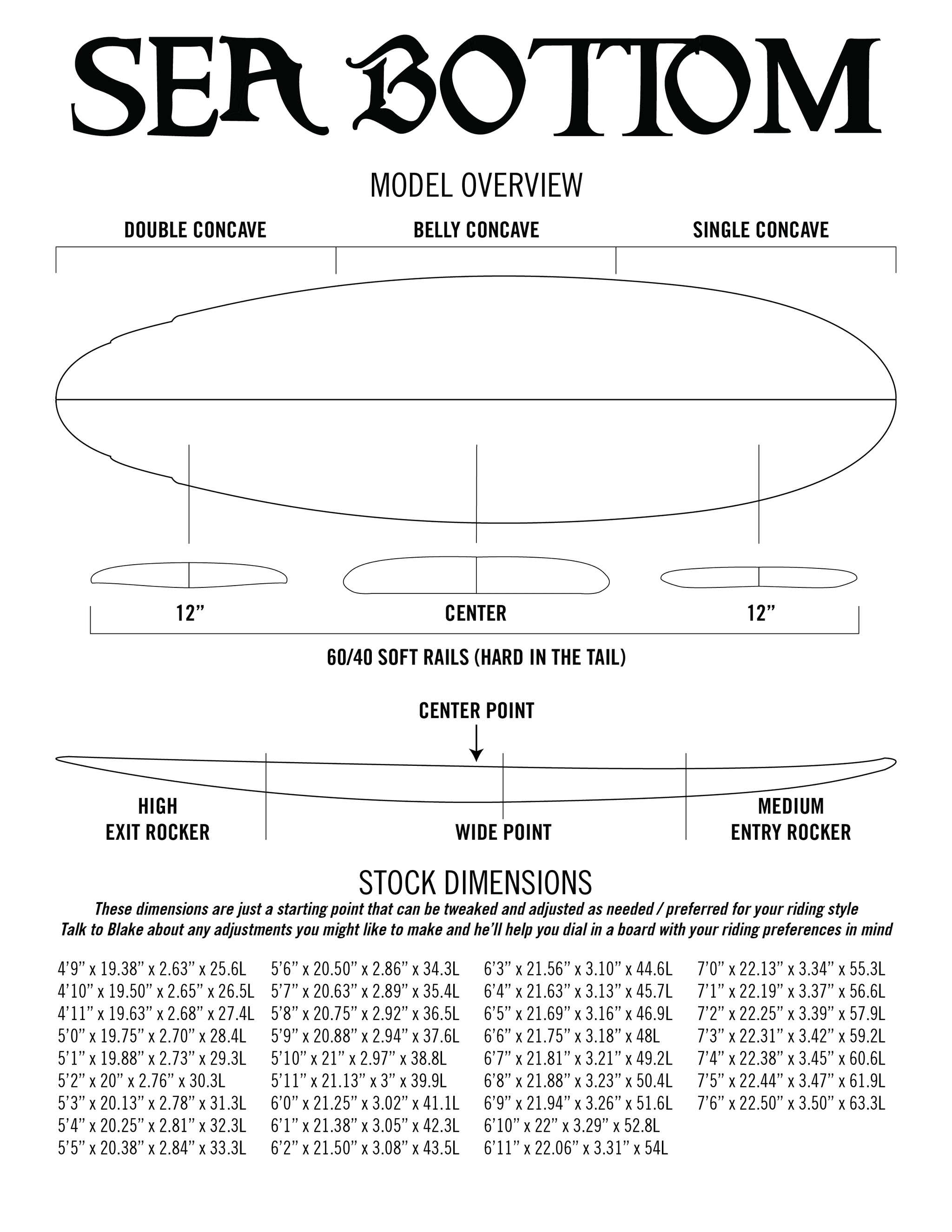
The bottom of the Sea Bottom is the whole pitch. The contour reads nose-to-tail as a single concave through the front section, a belly concave through the center, and a double concave through the tail — three distinct contours that hand water off to each other instead of running one shape across the full length. Combined with medium entry rocker and high exit rocker, this gives the front foot a clean, loaded surface that generates drive when the wave does not push on its own, while the higher exit rocker keeps the tail ready to release. 60/40 soft rails through the midsection with hard rails through the last 12 inches of the tail — forgiving rail-to-rail, clean release at speed.
WHAT IT WANTS
Knee-to-head-high points, soft beach break, and gliding reef. San Onofre on a clean morning, the long right at Saladita, Cardiff reef when the swell wraps. Made to glide — paddle into waves early, draw long lines through the section.
SKILL LEVEL
Intermediates and advanced surfers wanting a performance mid-length that bridges shortboard speed and longboard glide.
WHAT IT'S NOT
Not a high-performance shortboard — won't snap or whip the way a narrower-tailed board does. Not a longboard either — too short for traditional noseriding, too narrow for true tip time.
BUILD DETAILS
Build overview — rocker profile, rail shapes, fin positions. Hover any zone for the per-section call-outs.
WHERE IT WORKS
Soft-to-mid-range surf in two distinct registers. The shortboard band (5'8"–6'0", roughly 32–41 liters) runs as a deeper-belly performance hybrid for everyday SoCal — Salt Creek on a soft summer push, T-Street between sets, Cardiff Reef when the swell drops to chest-high. The mid-length band (6'8"–7'6", roughly 50–63 liters) runs as a modern mid-length for groovy point sessions and slower faces — San Onofre when the points go fat, the long shoulder of a Saladita point, a soft Mentawais reef-pass session. Same outline DNA in both bands; the deeper bottom keeps the board generating speed through soft sections in both registers.
WHO IT'S FOR
Confident intermediate through advanced surfers building a soft-wave quiver. The Sea Bottom is at its best lived as either the small-wave shortboard or the modern mid-length — not as a one-board-quiver bridge between them. Pick the shortboard band if you want a deeper-belly daily driver for chest-high-and-under SoCal. Pick the mid-length band if you want a paddle-and-glide-first board that still generates drive when you step on the gas. The 5-box fin layout on every Sea Bottom build means you can run thruster on a punchier day, quad or twin-plus-trailer when conditions soften — same physical board, different feel, no extra build.
THE DESIGN
A modern shortboard built for speed, response, and pressure on the rail. Specific rocker, concave, and outline tuning happen during the custom build conversation — built around your weight, your home break, and the conditions you ride most.
THE RAILS
Performance rails — soft through the front foot for forgiveness, tucked under the back foot for clean release. Rail thickness flexes by length and rider intent.
Custom builds are tuned to your dims and surfing style. Talk to Blake about specifics.
+ Not sure which size? Calculate your volume
Volumes are starting points, not rulebooks. Conditions, stance, and style all shift the math.
STOCK DIMENSIONS
Stock dimensions are where we start. Sea Bottom publishes in two bands — a shortboard band (5'8"–6'0", ~32–41L) and a mid-length band (6'8"–7'6", ~50–63L). Volume drives the call in both bands. Pick the same volume you ride in your daily shortboard for the shortboard band; size up by 6–10 liters over your shortboard volume for the mid-length band to load the longer rail. Talk to Blake about adjustments — width, thickness, and volume can all shift to match where you actually surf.
Featured sizes cover the core-liters range (32–41L) most of our customers land in. Need a size outside the band? Expand All sizes or start a custom order for a specific dim.
| Length | Width | Thickness | Volume |
|---|---|---|---|
| 5'3" | 20.13" | 2.78" | 31.3L |
| 5'4" | 20.25" | 2.81" | 32.3L |
| 5'5" | 20.38" | 2.84" | 33.3L |
| 5'6" | 20.50" | 2.86" | 34.3L |
| 5'7" | 20.63" | 2.89" | 35.4L |
| 5'8" | 20.75" | 2.92" | 36.5L |
| 5'9" | 20.88" | 2.94" | 37.6L |
| 5'10" | 21.00" | 2.97" | 38.8L |
| 5'11" | 21.13" | 3.00" | 39.9L |
| 6'0" | 21.25" | 3.02" | 41.1L |
+ How to think about dims
Length. The shortboard band wants knee-to-shoulder; the mid-length band wants waist-to-overhead with line. Sizing into the gap between the bands (6'2"–6'6") is technically possible but compromises both feels. Live the Sea Bottom as either the small-wave shortboard or the modern mid-length, not as a bridge between them.
Width. Narrower holds a line in clean, fast waves; faster rail-to-rail. Wider paddles better, more stable in softer surf, sits flatter on rail. Both bands of the Sea Bottom run a touch wider than their length-class default — that's intentional.
Thickness / volume. Volume drives the call. More volume = more paddle and more margin on soft days. Less volume = sensitive underfoot; rails sink cleanly; turns feel crisper. Size for the waves you actually surf, not the ones you hope to surf.
Between sizes? Size up in volume (not length) for softer waves, size down in volume for waves with more push.
Don't see your size? Message Blake
FIN SETUP
Thruster stock. Futures boxes. Twin + trailer and quad configurations also available — the shape rewards thruster's predictable tail release through faster sections, while twin + trailer opens up the looser, glide-leaning side of mid-length surfing.
Need help picking templates? Read the fin guide, then start a conversation — Blake's happy to talk it through before you lock the build.
Recommended Fins
Sea Bottom's deep single concave generates its own speed — the fins should complement that rather than fight it. Moderate-area fins with more flex let the board breathe and flow through its natural, groovy turns.
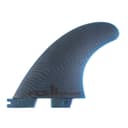
Performer
Medium-Large· Neo GlassAll-Around
Neo Glass flex matches Sea Bottom's laid-back personality. The Performer template keeps it versatile without adding unnecessary stiffness.
Shop FCS II →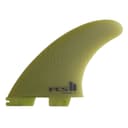
Carver
Large· Neo GlassPower / Hold
More area for hold through Sea Bottom's deep, drawn-out turns. Neo Glass flex keeps it flowing rather than stiff.
Shop FCS II →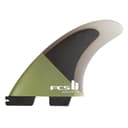
Carver
Medium· Performance CoreDrive / Rake-Leaning
More rake + larger area than the Performer. Holds drawn-out lines through head-high+ surf and rewards committed rail-to-rail carves. Reach for the Carver when the Performer feels too loose.
Shop FCS II →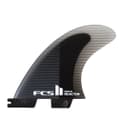
Reactor
Medium· Performance CorePivot / Top-to-Bottom
Upright template with shorter base — releases off the top vertically. The pick when you want tight, snappy shortboard surfing in punchy beach break.
Shop FCS II →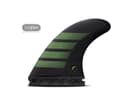
F8
Large· FiberglassAll-Around / Classic
Classic fiberglass flex with generous area. Lets Sea Bottom's concave do the work while the fins maintain smooth, flowing hold.
Shop Futures →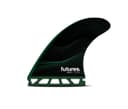
F8 Legacy Series
· HoneycombDrive / Rake-Leaning
Larger area + more rake than the F6. Sustained drive through long-line carves; the right Futures pick when you want hold over loose-tail release.
Shop Futures →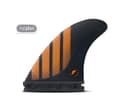
P6 Alpha
· AlphaPivot / Top-to-Bottom
Futures's P-series is their dedicated pivot template — upright leading edge, shorter base, vertical release. Pairs with shortboards built for punchy contest-style surfing.
Shop Futures →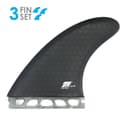
Channel Islands Tri Medium
Medium· HexcoreAll-Around / Mid-Rake
True Ames's CI-collab thruster — hand-foiled fiberglass hexcore tuned for the modern shortboard. Balanced rake plus clean foil response on Futures-compatible boxes.
Shop True Ames →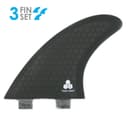
Channel Islands Tri Large
Large· HexcoreDrive / Rake-Leaning
Same CI-collab template scaled up. Larger area + more drive — the True Ames pick for shoulder-to-overhead surf where the Medium feels overwhelmed.
Shop True Ames →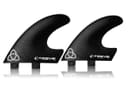
Apex
Medium-LargeAll-Around Performance
Balanced performance template that lets Sea Bottom's bottom contour do the talking. Clean foil for smooth water flow.
Shop NVS →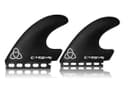
C-Drive Thruster Medium
Medium· ApexDrive / Rake-Leaning
NVS C-Drive cluster — drive-focused fiberglass hand-foil. Holds clean lines through committed turns; the NVS pick when JL feels too neutral and you want more drive off the bottom.
Shop NVS →Not sure which fin template is right for you? Rake, area, flex, and construction all change how a board feels.
Read the Complete Fin Guide →RAKE SPECTRUM
Where each recommended fin sits between drawn-out rake (heavier arcs, more hold) and tight pivot (vertical release, modern shortboard turning). Mid-rake (neutral) is the balanced default.
Drawn-out arcs. Power, hold, drive through long-line turns.
Balanced — drive plus pivot release. The everyday HPSB default.
Tight, vertical release. Modern shortboard pivot off the top.
 FCS IIPerformermid-rake (neutral)
 FCS IICarvermid-rake (neutral)
 FCS IICarverrake-leaning
 FCS IIReactorpivot-leaning
- FuturesAM2mid-rake (neutral)
 FuturesF8mid-rake (neutral)
 FuturesF8 Legacy Seriesrake-leaning
 FuturesP6 Alphapivot-leaning
 True AmesChannel Islands Tri Mediummid-rake (neutral)
 True AmesChannel Islands Tri Largerake-leaning
 NVSApexmid-rake (neutral)
 NVSC-Drive Thruster Mediumrake-leaning
On a high-performance shortboard, the spectrum reads: rake = drive priority through long-line carves; pivot = release off the top in steep pockets. Mid-rake (neutral) covers most everyday HPSB conditions.
WHAT TO PICK
Mid-rake (neutral) is the safest first pick on a high-performance shortboard — drive plus pivot release covers most clean shoulder-to-overhead conditions. Lean toward rake for heavier, drawn-out turns when the surf has push and shape; lean toward pivot for tight, top-to-bottom shortboard surfing in punchy beach break. Per-fin picks for this model are coming — message Blake for current recommendations across FCS, Futures, True Ames, and NVS.
SPECS REFERENCE
Full Build Specifications
Stock dimensions, rocker, bottom contour, rail profile, fin positions, recommended fins by brand, and shaper notes for shapers and partner shops.
AVAILABLE IN THE SHOP
Ready to ride. Stop by San Clemente or message us to claim one — they move fast.
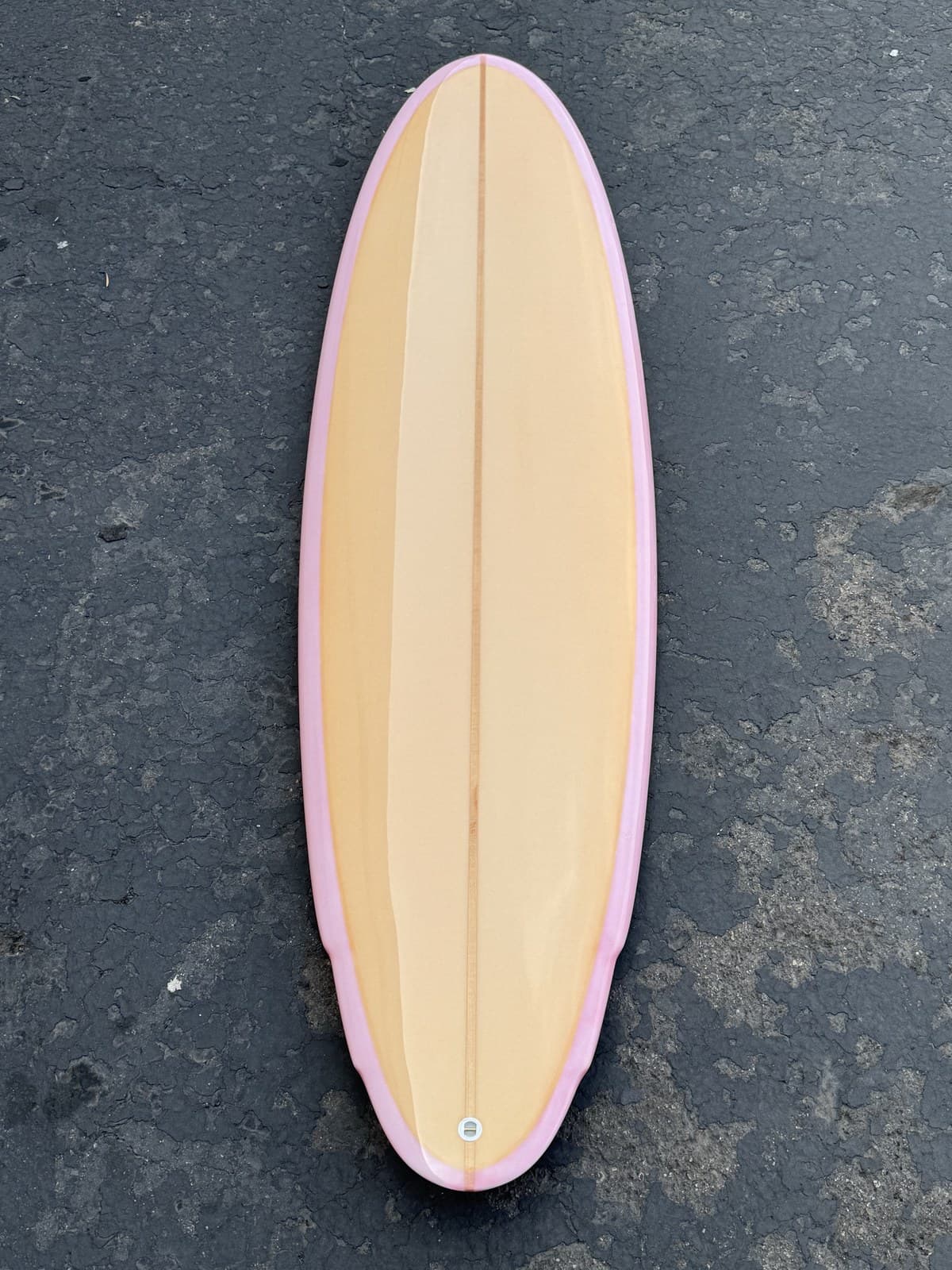
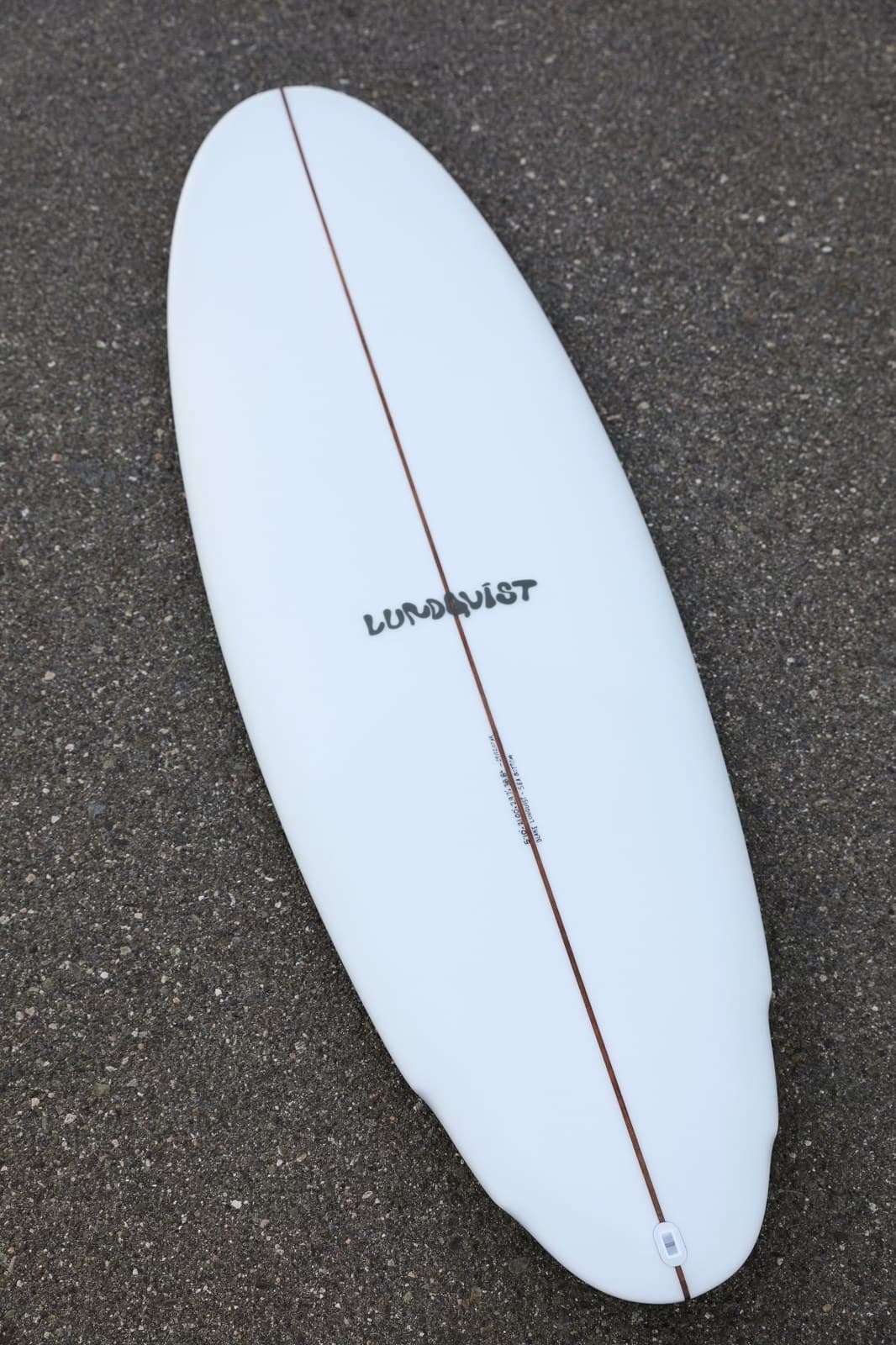
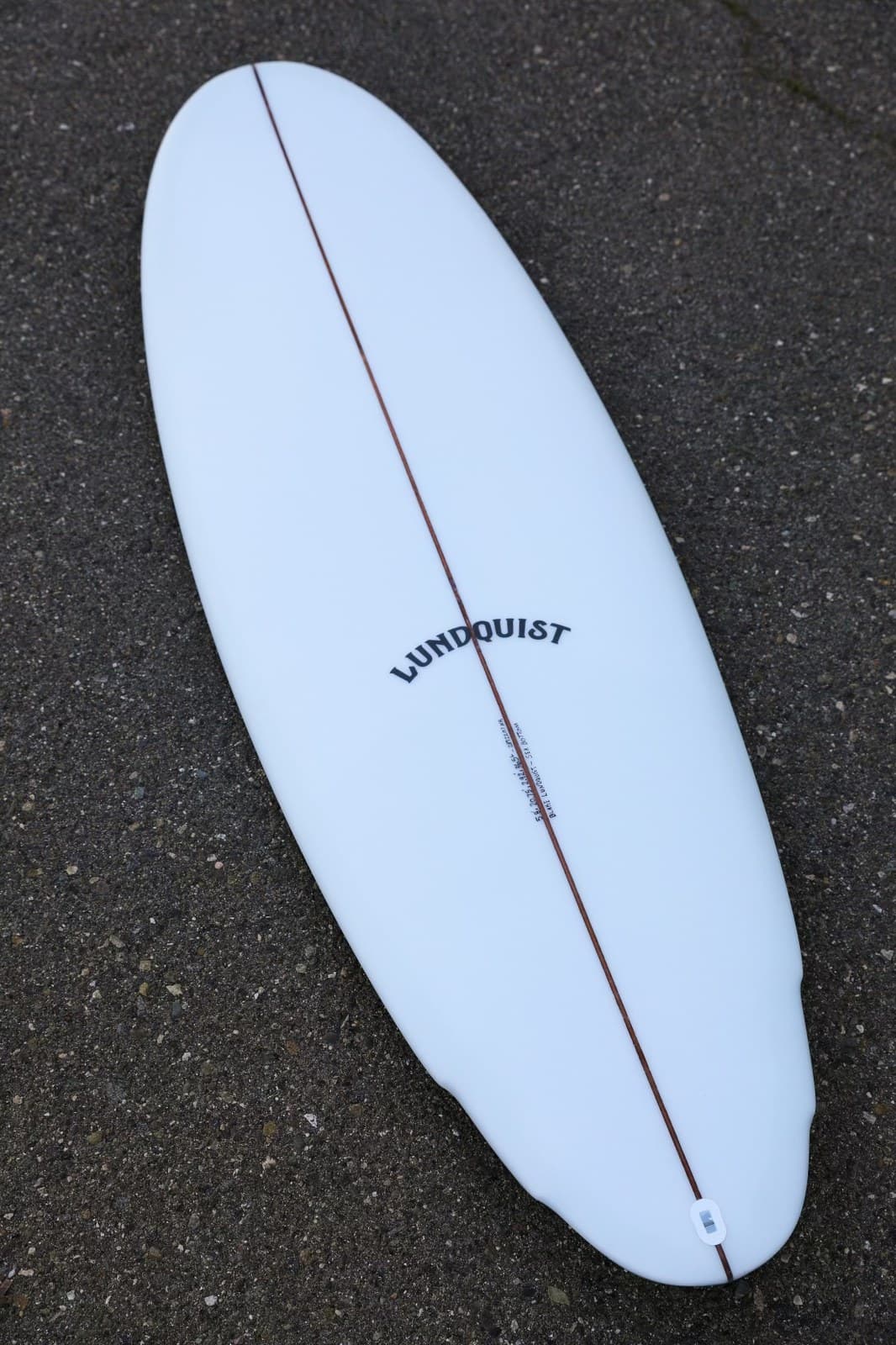
CONSTRUCTION & PRICING
Starting at $750 + tax
Every Sea Bottom is built to order in San Clemente. Pick a finish tier below; customize further in the next section.
Clear Resin Sanded
4-6 weeks
Functional finish, fastest turnaround. PU blank, polyester resin, sanded off the lam.
Resin Tint Sanded
6-8 weeks
Color both sides of the board in the lam, then sand it smooth.
Tint Gloss + Polish
8-10 weeks
Top-tier finish. Resin tint plus a gloss coat polished to show-quality.
Foam + Resin options
Customize your build
AESTHETIC
STRUCTURAL
TAIL VARIANTS
25% deposit today, balance due on completion. Timeline reflects current queue — confirmed on order.
Boards we've built
Recent customer builds — every Sea Bottom dialed to the rider.
2562201SR — Alex Trejos (7'2 glue lines)
2882207NR (5'8 Clear Simple)
2892207NR (5'8 Clear Simple)
2902207NR (5'10 Clear Simple)
2912207NR (5'10 Clear Simple)
2922207NR — NAME (6'0 Clear Simple)
2932207NR — Nate Harris (6'0 Clear Simple)
2942207NR (6'2 Clear Simple)
2952207NR — Chandler Jenson (6'2 Clear Simple)
2962207NR — Parker Wollostan (6'4 Clear Simple)
2972207NR — Parker Wollostan (6'4 Clear Simple)
2982207NR — Eric Corbridge (6'6 Blue)
2992207NR — Daniel Montgomery (6'6 Blue)
4062323MY — Nick Sass (6'0 Deep Blue G+P)
782203JE — Ben Young (6'6 Burnt Umber)
962207JLY — Dan Nelson (6'4 Green)
GO DEEPER
Every construction call links to a full guide. Start with the essentials:
Board Details Checklist
Everything we need from you to begin your custom build.
Learn more →
Foam & Resin Types
Understanding the materials that make up your board's core and shell.
Learn more →
Fins — A Complete Guide
Single fins to thrusters, base systems, sizing by weight + wave, and how to pick across True Ames, NVS, Futures, and FCS.
Learn more →
Gloss + Polish vs Sanded Finish
The final touch that defines how your board looks and feels.
Learn more →
FREQUENTLY ASKED QUESTIONS
What size Sea Bottom should I get?
Volume drives the call in both bands. For the shortboard band (5'8"–6'0", 32–41 liters), pick roughly the same volume you ride in your daily shortboard — the deeper bottom adds drive without adding bulk, so you don't need to size up for paddle. For the mid-length band (6'8"–7'6", 50–63 liters), size up by 6 to 10 liters over your shortboard volume to load the longer rail and get the paddle-and-glide feel that makes the mid-length band worth picking. If you're between two sizes, size up in volume — not length — for softer waves, and size down in volume for waves with more push. Talk it through with me on a custom order if you want a second opinion.
What fin setup does the Sea Bottom run, and can I switch?
Every Sea Bottom ships with a five-box fin layout — three center rear plus two sides — which means the same physical board runs as a thruster, a quad, or a twin-plus-trailer depending on what you plug in. Thruster is the punchier setup for clean waves with shape; quad loosens the board down the line and tightens up the drive through softer sections; twin-plus-trailer goes looser still and is the right call for waist-high beach-break days where you want the board to slide. Default box system is FCS II or Futures, your pick at order. The full template recommendations across Futures, FCS II, True Ames, and NVS publish after the rake-vs-pivot fin guide deep-dive lands — start a custom order and I'll walk through which template fits your weight, stance, and the waves you're riding most.
What waves is the Sea Bottom built for?
Soft-to-mid-range surf in two registers. The shortboard band runs as a deeper-belly performance hybrid for everyday SoCal — Salt Creek on a soft summer push, T-Street between sets, Cardiff Reef when the swell drops to chest-high. The mid-length band runs as a modern mid-length for groovy point sessions and slower faces — San Onofre when the points go fat, the long shoulder of a Saladita point on a mainland Mexico trip, a soft Mentawais reef-pass session where you want one board for the dawn-patrol session and the afternoon glass. Both bands are at their best knee-to-shoulder (shortboard band) or waist-to-overhead with line (mid-length band). When the surf gets hollow and fast — Lowers on a real swell, an overhead Mentawais reef day with push — a flatter, more-rockered shape handles the same wave with less hesitation in the pocket; that's not what the Sea Bottom is built for.
Who's the Sea Bottom for, skill-wise?
Confident intermediate through advanced surfers building a soft-wave quiver. The shortboard band rewards you for being on the front foot — if you're still figuring out where to stand on a performance shape, a wider, flatter shortboard will give you more margin while you sort that out, and you can come back to the Sea Bottom when the front-foot drive starts paying off. The mid-length band is friendlier to a wider range — if you've ridden any mid-length before, the Sea Bottom in its 6'10"–7'2" sizes will feel familiar in the lineup. The shape is at its best lived as either the small-wave shortboard or the modern mid-length. It's not a one-board-quiver buyer's pick; it's a quiver-builder's pick.
How long does a built-to-order Sea Bottom take?
Lead time depends on the finish tier and the current queue. Clear-resin sanded is the fastest at four to eight weeks (4–6 for the shortboard band, 6–8 for the mid-length band). Tinted-both-sides sanded runs eight to ten weeks. Top-tier resin tint plus gloss-and- polish runs six to eight weeks. Every Sea Bottom is designed in Shape3D, CNC-cut from a PU blank, and finished by Jack Sykes here in San Clemente. We confirm the timeline at order based on the live queue. Twenty-five percent deposit at order; balance due on completion.
How does the Sea Bottom compare to the Sharpeye Holy Toledo?
They're cousins, not twins. The Holy Toledo is the closest public five-fin convertible hybrid to the Sea Bottom's shortboard band — both run a deep concave through the bottom and both convert between thruster, quad, and twin-plus-trailer on the same board. Two real differences: the Sea Bottom carries that DNA up into a 6'8"–7'6" modern mid-length range, which the Holy Toledo doesn't (Sharpeye runs a separate mid-length lineage). And the Sea Bottom is built to your specs — width, thickness, volume, tail shape, glass schedule, finish, and fin system all dial at order — whereas a stock-line Holy Toledo ships closer to a single recipe. If you're shopping the Sea Bottom shortboard band against a Holy Toledo, the comparison is fair; if you're shopping the mid-length band, the closer comparison is the Christenson Ultra Tracker or a Ryan Lovelace V.Bowls.
What's the glassing on a Sea Bottom?
Two defaults, one per band. The shortboard band ships standard on a four-ounce-S-cloth-plus-four-ounce-warp deck and a four-ounce-S bottom — the lighter spec keeps the rail responsive under foot. The mid-length band ships heavier on the deck — six-ounce-S plus four-ounce warp — because the longer rail needs more support under the front foot when you load it; bottom is four-S-plus-four-warp on the mid-length to keep the bottom stiff. Both bands run polyester resin on a PU blank as the standard build. Sanded finish is standard on every tier; gloss-and-polish is a $200 upcharge on the mid-length band and gives you the show-quality finish if you want the board to look as deliberate as it rides. Deck patches and volan tail patches are available as add-ons; I'll recommend a patch on the deck if your weight or surfing style asks for it.
Why does the Sea Bottom have three different bottom contours along its length?
Because each section of the bottom does a different job. The single concave through the front section gives the lead foot a clean, loaded surface and lifts the board onto plane the moment you stand up — that's the part of the board that decides whether you can get speed out of a soft takeoff. The belly concave through the center is the shape's headline feature: it sits the board a touch deeper in the water through the planing zone, which generates drive when the wave itself isn't pushing on its own. The double concave through the tail splits water behind the fins so the board can release cleanly out of a turn. Three contours handing water off to each other lengthwise — that's why the Sea Bottom keeps generating speed through soft sections where a flatter, single-bottom shape would stall.
Cross-reference + voice audit
- Voice rules honored: no "stoke", "shred", "boost", "send it", "ripper", "fire". No "hand-shaped". No comparison to another Lundquist model in any answer (Innuendo, Spectre, etc. are not named). - Geographic anchors: Salt Creek, T-Street, Cardiff Reef, San Onofre (SoCal); Saladita, Mentawais, mainland Mexico (travel). - Builder reference: Holy Toledo (Sharpeye), Ultra Tracker (Christenson), V.Bowls (Ryan Lovelace) — all from the `descriptions.md` §6 competitor table. - Q8 contour grounding: pulls directly from the Vision read of `Contour Diagrams/13. Sea Bottom/3. PNGs/Sea Bottom Contour Diagram.png` — single concave (nose) → belly concave (center) → double concave (tail), 60/40 soft rails with hard-tail release. - Top three for FAQPage JSON-LD: Q1 (sizing), Q2 (fin setup), Q3 (wave range).
MORE SHORTBOARDS
EXPLORE THE LINEUP
Innuendo
shortboard
Salt Burn
twin fin
Spectre
mid length
Fantasma
longboard
Scorpio
shortboard
Talisman (Mini Gun)
gun
Dutchman
glider
Rage
wake surf
2nd to None
shortboard
Suds
twin fin
Esplanade
mid length
Black Pearl
longboard
Talisman (Step Up)
shortboard
Talisman (Gun)
gun
Wake Surf #2
wake surf
Gumball
shortboard
Revenant
twin fin
Sea Bottom
shortboard
Lunada
longboard
Five Horizons
shortboard
Pin Twin
twin fin
Whip-Stitch
mid length
Big Joe
longboard
Wanted
shortboard
Duppy
twin fin
Serenata
mid length
Legacy
longboard
Gold
shortboard
Lucid
twin fin
Hiatus
mid length
Magic Carpet
longboard
Moon Shine
shortboard
Boomerang
twin fin
Apparition
shortboard
Half-Moon
twin fin
Bang!
shortboard
Aardvark
twin fin
Lasso
shortboard
Acid-Drop
twin fin
Popsicle Stick
shortboard
Big Buoy
shortboard
Pegasus
longboard
COMPLETE THE QUIVER
“Surf Everyday” means a board for every condition. Your Sea Bottom covers soft-to-mid push, knee-to-overhead with line— here's what rounds out the quiver.

Innuendo— Shortboard
Sister shortboard in the Lundquist line — different rocker, foil, and outline character. See the Innuendo page for the full breakdown.
Learn more →

2nd to None— Shortboard
Sister shortboard in the Lundquist line — different rocker, foil, and outline character. See the 2nd to None page for the full breakdown.
Learn more →

Gumball— Shortboard
Sister shortboard in the Lundquist line — different rocker, foil, and outline character. See the Gumball page for the full breakdown.
Learn more →
Building a quiver around the Sea Bottom? Start a conversation — we'll build the right boards for how and where you actually surf.
More boards live in the website catalog than at the shop. Visits are by appointment — text or call (949) 750-5067 to look at boards in person or start a custom build.
READY TO START?
Every Sea Bottom is built to order in San Clemente — 4–6 weeks on clear-sanded, 6–8 weeks gloss and polish, 8–10 weeks tint-sanded. 25% deposit.
Shop: 106 W Mariposa Unit B, San Clemente, CA 92672
By appointment · 8am–8pm daily · (949) 750-5067