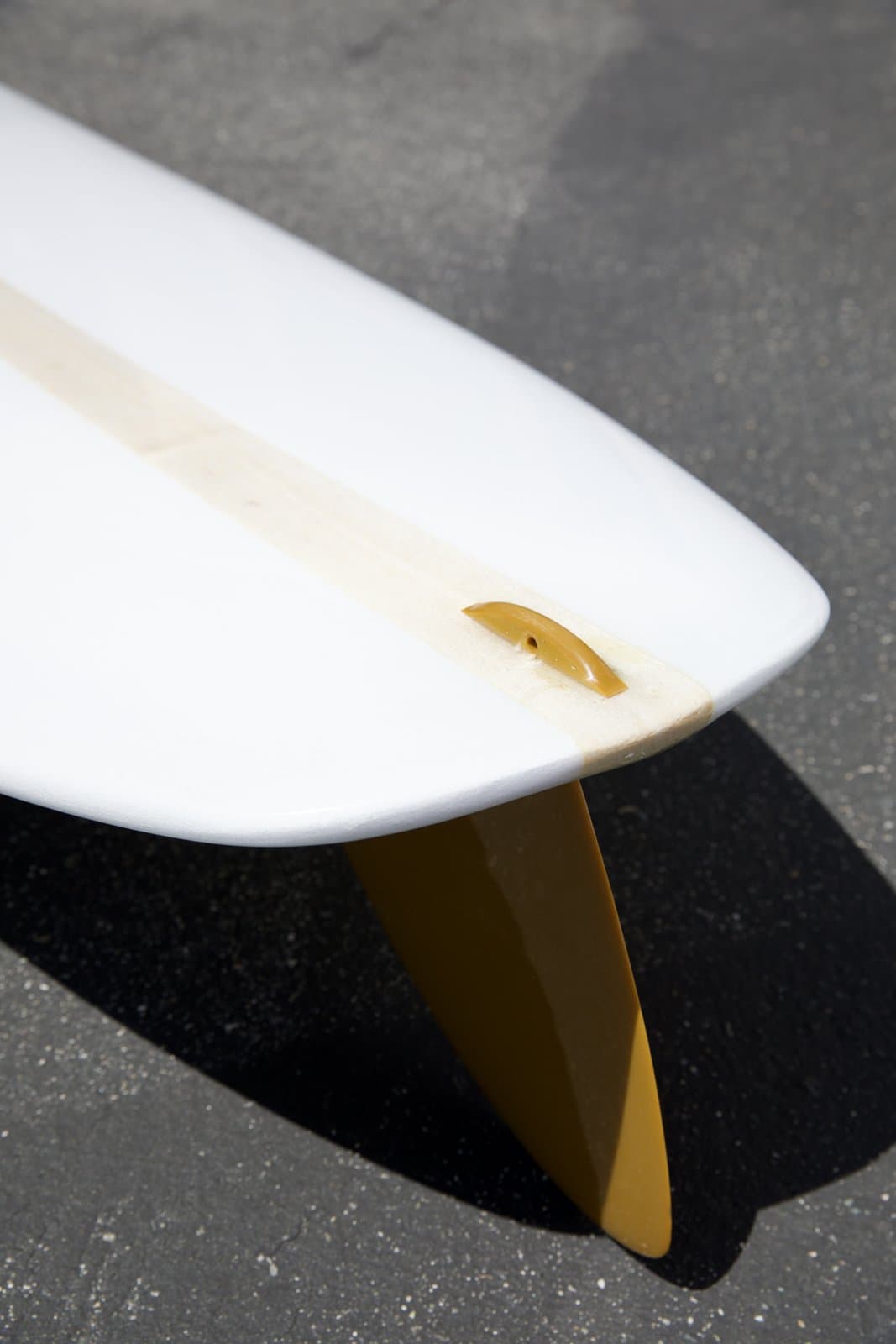
One of two traditional leash attachment options we offer on every Lundquist longboard. The glassed leash loop (sometimes called a resin leash loop) is a small loop of fiberglass cord or string glassed directly onto the deck near the tail — no plastic plugs, no deck plug hardware, no drilling.
What It Is
A glassed leash loop is a short piece of fiberglass-reinforced cord or string that gets laminated onto the deck near the tail during the bottom or deck glass job. The loop itself sits proud of the deck — roughly 2.5" long × 1/2" wide × 1/2" tall — so the customer can thread their leash string straight through it and tie off, exactly the way they would with a plastic leash plug.
The loop is oriented north-to-south parallel with the stringer, positioned on or near the stringer 2–4 inches up from the tail block. No plastic. No metal D-ring. No drilled passages. Just a clean fabric loop bonded into the glass job.
The loop itself is always glassed with clear resin. If the board has a resin tint on the deck underneath, that color will show through the clear loop — which is part of the look. The loop is never pigmented on its own.
Why We Offer It
Heritage-correct. This is one of the two techniques longboard builders have used since before plastic leash plugs existed. Old hand-shapers favored this method for its simplicity — no routing, no plug to set, just a loop glassed in during normal lamination.
Clean lines. There's no visible plug, no recessed cup, no metal ring. The only element on the deck is a small, subtle fabric loop that sits flush when no leash is tied to it.
Structurally integrated. Because the base of the loop is laminated into the glass job itself, it becomes part of the board's structure. There's nothing to pop out or pull loose. To remove it, you'd have to grind through the glass.
Simple to service. If the loop ever frays or wears through, a shaper can re-glass a new one in the same spot. Most never need replacement.
How We Install It
The loop is installed during the glass job, not after:
- Form the loop. A short length of leash cord or fiberglass cord is bent into an arc — the arc itself ends up being the loop the customer threads their leash string through.
- Position on the stringer. The loop is laid on the deck near the tail, centered on or near the stringer, oriented north-to-south parallel with the stringer, typically 2–4 inches up from the tail block.
- Glass in the base. During lamination, small patches of fiberglass cloth are laid over the base of the loop (where it meets the deck), saturated with resin, and worked down into the weave. The loop itself stays proud of the cloth so the customer can still thread through it.
- Sand and finish. Once the glass cures, the glassed base is sanded smooth and finished with the rest of the board.
The result: a permanent, low-profile loop sitting on the deck, mechanically bonded into the board's structure.
Glassed Loop vs. Through-Box Leash
Both options are traditional, plug-free, and look right on a classic longboard. The short version:
- Glassed leash loop (this guide) — small fiberglass loop glassed onto the deck near the tail during lamination. Loop is visible on the deck, but no plug, no ring, no hardware. No drilling.
- [Through-box leash](/build-guide/through-box-leash) — hole drilled through the fin box, string threaded through, knot hidden inside. Nothing visible on the deck or bottom. Requires a drilled and resined passage in the fin box.
Neither is better than the other — it's builder and owner preference. Both are offered on every Lundquist longboard in the Board Builder.
When We Use It
Glassed leash loops are an option on every Lundquist single-fin longboard and glider: Black Pearl, Salt Burn, Lunada, Dutchman, Spectre, Legacy, Magic Carpet, Fantasma, and every other longboard in the lineup.
We don't use glassed leash loops on multi-fin boards. Shortboards, twin fins, mid-lengths, and thrusters get a standard leash plug near the tail.
The Takeaway
If you prefer a heritage technique — a small, intentional fabric loop rather than a plastic plug or a drilled passage — the glassed leash loop is the option for you. Select it in the Board Builder when ordering, or if you'd rather keep the deck and bottom both completely clean of any visible attachment, choose the through-box leash instead.