
Dutchman
A long, narrow single-fin built for trim, paddle, and patience.
The Dutchman is the longest board in the Lundquist line — a single-fin glider designed around one premise: the board that pays rent in soft surf is the board that keeps moving when the wave goes flat.
WHAT IT WANTS
Knee-to-chest-high glide — the smallest, weakest waves in the lineup. Summer San Onofre, lazy Doheny mornings, the inside section at Cardiff. Built to make the smallest days surfable.
SKILL LEVEL
All skill levels — particularly riders who want to maximize wave count on small days.
WHAT IT'S NOT
Not for waves with real push or hollow shape. Specifically tuned for the smallest, softest surf — out of scope for shoulder-high+ days.
BUILD DETAILS
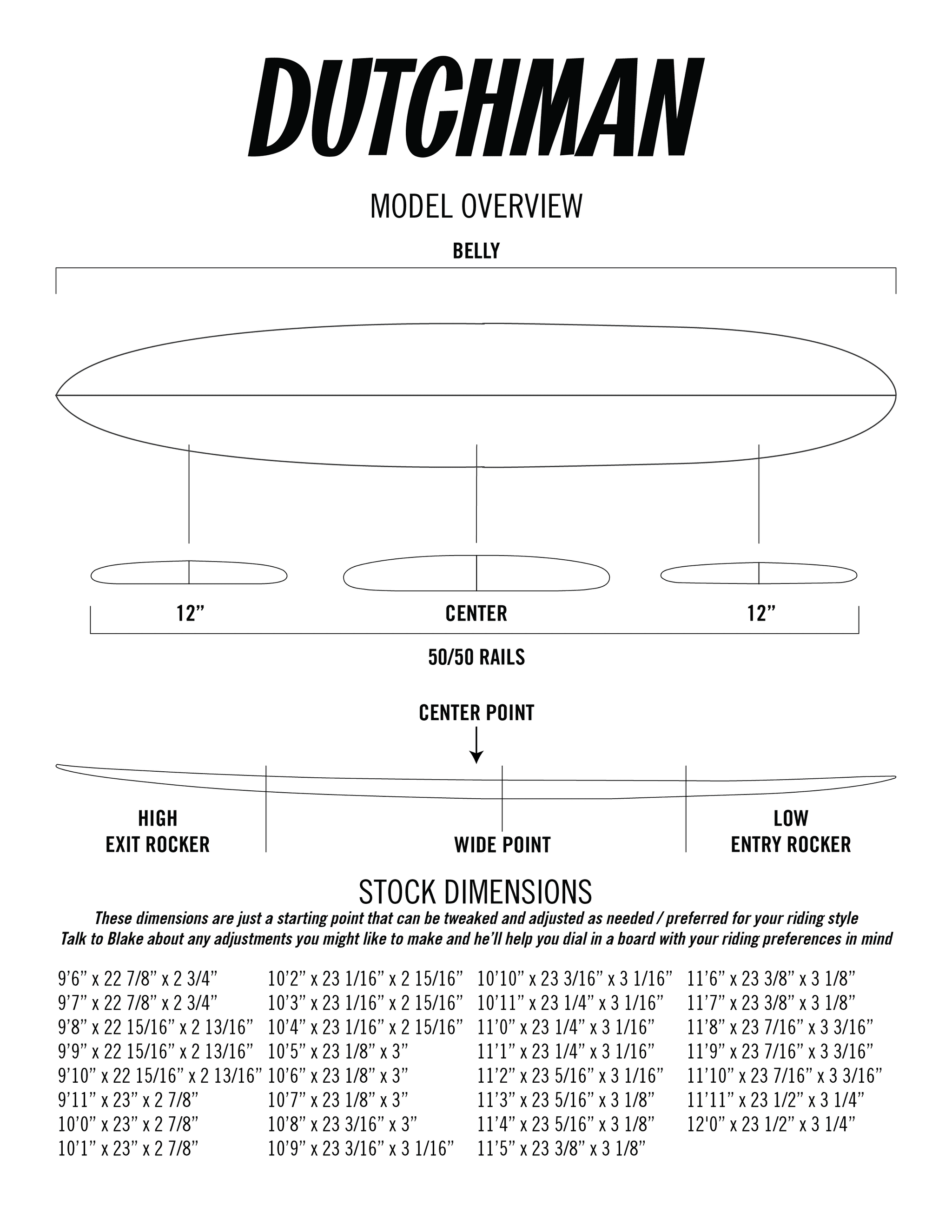
Build overview — rocker profile, rail shapes, fin positions. Hover any zone for the per-section call-outs.
HOW IT'S DESIGNED
Low entry rocker through the nose lets the board catch a wave before the lip exists — the nose drops cleanly onto the water without pearling, paddling through swells a 9'6" longboard would miss. A single belly bottom runs the length of the board: no concave channels, no hard edges underneath — the bottom rolls from rail to rail and lets the board flow into a trim line naturally. 50/50 rails along the full length hold a clean line through long drawn-out turns; high exit rocker keeps the tail alive off the top when the wave asks. Single fin stock (10" center box); optional 2+1 side bites 12" off each rail at custom checkout.
WHERE IT WORKS
Built for SoCal point mornings — San Onofre when the south wraps soft and the inside section reels for a hundred yards, Doheny at dawn when it's glassy and waist-high, Cardiff Reef when the summer pulse opens up the inside. Past California, this is the board that lives in your travel bag for Mexican cobblestone points: Saladita on a clean morning, Punta Mita on a soft swell. Not the board for Lowers on a head-high day — the Dutchman trades top-turn snap for paddle, glide, and an unbroken arc through the entire face.
THE DESIGN
A glider is a longboard pushed past 9'6" — usually 10'0" through 12' — built around speed-from-shape. Single-fin trim on a wide, long, low-rocker outline that lets you ride waves earlier and hold the line further down the face.
THE RAILS
Full 50/50 rails through the body for trim hold. Soft tucked tail rails for clean release. Glider rails carry more volume than a longboard at the same width, which is what gives a glider its float and paddle.
Custom builds are tuned to your dims and surfing style. Talk to Blake about specifics.
STOCK DIMENSIONS
The Dutchman lives between 10'6" and 12'0" — the upper end of the Lundquist glider-gun pricing tier. Length is the engine: every inch beyond 10 feet is paddle power, glide-through-flat-section, and trim authority. Width stays narrow — wide gliders surf like wide longboards, and that is not the point. Volume is intentionally not displayed: gliders are a length-and-width conversation, not a liter conversation. Talk to Blake about any adjustments you'd like to make — he'll dial in a board with your riding preferences in mind.
| Length | Width | Thickness |
|---|---|---|
| 9'6" | 22 ⅞" | 2 ¾" |
| 9'7" | 22 ⅞" | 2 ¾" |
| 9'8" | 22 ¹⁵⁄₁₆" | 2 ¹³⁄₁₆" |
| 9'9" | 22 ¹⁵⁄₁₆" | 2 ¹³⁄₁₆" |
| 9'10" | 22 ¹⁵⁄₁₆" | 2 ¹³⁄₁₆" |
| 9'11" | 23" | 2 ⅞" |
| 10'0" | 23" | 2 ⅞" |
| 10'1" | 23" | 2 ⅞" |
| 10'2" | 23 ¹⁄₁₆" | 2 ¹⁵⁄₁₆" |
| 10'3" | 23 ¹⁄₁₆" | 2 ¹⁵⁄₁₆" |
| 10'4" | 23 ¹⁄₁₆" | 2 ¹⁵⁄₁₆" |
| 10'5" | 23 ⅛" | 3" |
| 10'6" | 23 ⅛" | 3" |
| 10'7" | 23 ⅛" | 3" |
| 10'8" | 23 ³⁄₁₆" | 3" |
| 10'9" | 23 ³⁄₁₆" | 3 ¹⁄₁₆" |
| 10'10" | 23 ³⁄₁₆" | 3 ¹⁄₁₆" |
| 10'11" | 23 ¼" | 3 ¹⁄₁₆" |
| 11'0" | 23 ¼" | 3 ¹⁄₁₆" |
| 11'1" | 23 ¼" | 3 ¹⁄₁₆" |
| 11'2" | 23 ⁵⁄₁₆" | 3 ¹⁄₁₆" |
| 11'3" | 23 ⁵⁄₁₆" | 3 ⅛" |
| 11'4" | 23 ⁵⁄₁₆" | 3 ⅛" |
| 11'5" | 23 ⅜" | 3 ⅛" |
| 11'6" | 23 ⅜" | 3 ⅛" |
| 11'7" | 23 ⅜" | 3 ⅛" |
| 11'8" | 23 ⁷⁄₁₆" | 3 ³⁄₁₆" |
| 11'9" | 23 ⁷⁄₁₆" | 3 ³⁄₁₆" |
| 11'10" | 23 ⁷⁄₁₆" | 3 ³⁄₁₆" |
| 11'11" | 23 ½" | 3 ¼" |
| 12'0" | 23 ½" | 3 ¼" |
+ How to think about dims
Length. Longer = more paddle, more glide, longer trim line. Shorter (within the glider window) = quicker rail-to-rail, easier to redirect off the back foot. Below 10'6" you've left the glider window — that is a different category of board.
Width. Narrower = holds a line in clean glassy point surf; faster rail-to-rail; cleaner foil through the flat section. Wider = more paddle power, more stability under foot, a softer-feeling board overall.
Tail shape. Pintail (default) = maximum hold, longest arc, classic glider DNA. Round-pin = slightly more pivot, easier to redirect when the wave asks. Diamond = modern-classic look, breaks up the visual length, retains hold without going full-pin.
Between sizes? On a glider, size up. The longer board paddles better, glides further, and trims cleaner. The only reason to size down is if the lineup you ride most often genuinely cannot hold an 11-foot board.
Don't see your size? Message Blake
FIN SETUP
Single fin only. 10.5" Stavron long box. The Stavron box is the longboard standard — runs longer, deeper fins than a standard FCS or Futures system, and gives you full fore-aft tuning for noseriding vs trim. We don't offer 2+1 or thruster on this shape.
Need help picking templates and brands? Read the fin guide, then start a conversation — Blake's happy to talk it through before you lock the build.
Recommended Fins
The Dutchman is a glider — its length and volume already provide stability. The fin gives direction without anchoring the tail. Mid-rake / slight-rake classic single-fin templates in the 7"-9.5" range are the canonical glider setup; sweet spot 8"-8.5". Pivot fins are an acceptable personal-preference alternative for surfers who want a looser, more responsive feel — a different riding style than the trim-and-glide approach the Dutchman is built for.
Mid-Rake (Neutral) pick
Message Blake for our current FCS II mid-rake (neutral) pick pick.
Call (949) 750-5067 →Mid-Rake (Neutral) pick
Message Blake for our current Futures mid-rake (neutral) pick pick.
Call (949) 750-5067 →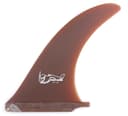
Greenough 4-A
9"· VolanClassic Glider / Mid-Rake
Greenough template at glider-friendly 9-inch length. Clean foil and moderate rake let the board's length carry the trim line; the fin gives direction without anchoring the tail.
Shop True Ames →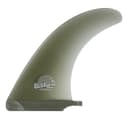
California Classic
9.5"· Solid FiberglassClassic Glider / Slight-Rake
Wider base + slightly more area at 9.5" — top of the glider window. The cruiser pick when you want maximum stability and the longest trim line.
Shop True Ames →Mid-Rake (Neutral) pick
Message Blake for our current NVS mid-rake (neutral) pick pick.
Call (949) 750-5067 →Not sure which fin template is right for you? Rake, area, flex, and construction all change how a board feels.
Read the Complete Fin Guide →GLIDER FIN PHILOSOPHY
Gliders are designed for trim and glide, not pivot turning. The board's length and volume already provide stability — the fin's job is to give direction without anchoring the tail.
Smaller fins (7"–9.5", with 8"–8.5" as the sweet spot) let the board do the work. Mid-rake and classic single-fin templates are the canonical setups. Pivot fins are an acceptable personal-preference choice — looser, more responsive, but a different style of riding than the trim-line approach gliders are built for.
RAKE SPECTRUM
Where each recommended fin sits between drawn-out rake (heavier arcs, more hold) and tight pivot (vertical release, modern shortboard turning). Mid-rake (neutral) is the balanced default.
Drawn-out arcs. Power, hold, drive through long-line turns.
Balanced — drive plus pivot release. The everyday HPSB default.
Tight, vertical release. Modern shortboard pivot off the top.
- FCS IICustom — message Blakemid-rake (neutral)
- FuturesCustom — message Blakemid-rake (neutral)
 True AmesGreenough 4-Amid-rake (neutral)
 True AmesCalifornia Classicrake-leaning
- NVSCustom — message Blakemid-rake (neutral)
On a glider, the spectrum reads: mid-rake / slight-rake = the canonical conversation. Pivot fins are an acceptable personal-preference alternative for surfers who want a looser, more responsive feel — different riding style than the trim-and-glide approach a glider is built for.
WHAT TO PICK
Gliders run their own fin philosophy — distinct from longboards. Single-fin templates only in the 7"-9.5" range (sweet spot 8"-8.5"). The board's length and volume already provide stability; the fin's job is to give direction without anchoring the tail. Mid-rake / slight-rake / classic single-fin templates are the canonical setups. Per-fin picks for this model are coming — message Blake for current recommendations.
SPECS REFERENCE
Full Build Specifications
Stock dimensions, rocker, bottom contour, rail profile, fin positions, recommended fins by brand, and shaper notes for shapers and partner shops.
CONSTRUCTION & PRICING
Starting at $1,375 + tax
Every Dutchman is built to order in San Clemente. Pick a finish tier below; customize further in the next section.
Clear Resin Sanded
4-6 weeks
Functional finish, fastest turnaround. PU blank, polyester resin, sanded off the lam.
Resin Tint Sanded
6-8 weeks
Color both sides of the board in the lam, then sand it smooth.
Tint Gloss + Polish
8-10 weeks
Top-tier finish. Resin tint plus a gloss coat polished to show-quality.
Foam + Resin options
Customize your build
AESTHETIC
STRUCTURAL
TAIL VARIANTS
25% deposit today, balance due on completion. Timeline reflects current queue — confirmed on order.
Boards we've built
Recent customer builds — every Dutchman dialed to the rider.
27662128DR — Nate Phipps (11'7 Clear Volan)
4292313SR — Ben Young (9'9 CS)
92125JE — Nate Phipps (11'11 Red)
GO DEEPER
Every construction call links to a full guide. Start with the essentials:
Board Details Checklist
Everything we need from you to begin your custom build.
Learn more →
Foam & Resin Types
Understanding the materials that make up your board's core and shell.
Learn more →
Fins — A Complete Guide
Single fins to thrusters, base systems, sizing by weight + wave, and how to pick across True Ames, NVS, Futures, and FCS.
Learn more →
Gloss + Polish vs Sanded Finish
The final touch that defines how your board looks and feels.
Learn more →
FREQUENTLY ASKED QUESTIONS
What size Dutchman should I order?
Length is the engine on a glider — every inch beyond 10 feet is paddle power and glide. For most riders 150–190 pounds, an 11'0" is a strong starting point. Lighter riders (under 150) and faster-wave specialists can drop to 10'6"–10'8". Heavier riders (200+ pounds) or anyone whose home break is consistently soft and flat should look at 11'4"–12'0". On a glider, when you're between sizes, size up — the longer board paddles better, glides further, and trims cleaner. Talk to Blake before you lock the dim.
Why a single fin?
The single fin is what makes a glider a glider. It gives the board authority through a long arc, has the cleanest connection between rail and bottom, and adds no extra surface area to drag in the flat section between turns. The contour diagram shows a 10" center box with optional 2+1 side-bite positions 12" off each rail — single-fin stock, 2+1 available at custom checkout for surfers who want trim plus the option to hold a longer arc on a steeper face.
Why low entry rocker and high exit rocker?
You can see both in the contour diagram — and the combination is the design move that defines the Dutchman. Low entry rocker through the nose lets the board catch a wave before the lip exists; the nose drops cleanly onto the water without pearling, and you're paddling through swells a 9'6" longboard would miss. High exit rocker keeps the tail alive off the top — the board is not locked into pure trim, it can still turn when the wave asks. Together, they let one board handle both the paddle-and-glide opening and the section-redirect at the end of a long ride.
What waves is the Dutchman built for?
Soft, peeling point waves — knee-to-shoulder-high. Think San Onofre on a soft south, Doheny at dawn, Cardiff Reef when the summer pulse opens up the inside, Saladita on a clean morning, Punta Mita on a soft swell. The Dutchman wants wave count, not wave size — a glassy face it can draw a long line across. It is not the board for Lowers on a head-high day or for hollow, heavy surf. The trade-off is length-for-snap: paddle, glide, and trim authority in exchange for top-turn snap and tube-hunting.
How does the Dutchman compare to a Christenson Bonneville or an Andreini Vaquero?
Same family. The Bonneville (Christenson), Vaquero (Andreini), and Eagle (Frye/Harbour) define the modern SoCal glider center of gravity — narrow templates, low rocker, single-fin authority, pintail hold. The Dutchman shares that hydrodynamic premise. The differences are the ones you specify at custom checkout: tail shape (pin / round-pin / diamond), fin box brand, glass schedule, finish tier. Designed in CAD by Blake; CNC-cut and finished by Jack Sykes in San Clemente.
What glassing schedule comes on a Dutchman?
The proposed default for an 11-foot board is 8oz + 6oz volan on the deck and 6oz volan on the bottom — a heavier deck for foot-traffic durability, a single bottom layer to keep weight reasonable across 11 feet of board. Stringer is 3/8" basswood for longitudinal stiffness. Foam is PU (US Blanks); EPS is not recommended for this category. All defaults are tunable at custom checkout — see the glassing schedules guide for the trade-offs.
How long does a Dutchman take to build?
4–6 weeks on a clear-sanded build, 6–8 weeks on gloss-and-polish, 8–10 weeks on tint-sanded. Long boards take longer to glass and sand than shortboards, so add a week if you're between tiers and deciding. Turnaround reflects current queue — confirmed when you place the order. Lock your slot with a 25% deposit.
Can I demo a Dutchman before ordering?
We don't run a formal demo program for gliders — at 11 feet, demo boards are hard to keep on the rack and harder to ship. What we do: book a paddle session at San Onofre with Blake, and ride whichever Dutchman or comparable single-fin glider is on hand. If you're local to SoCal, message ahead. If you're not, the closest non-demo path is to read the descriptions and the contour diagram together, message Blake your weight + home break + experience, and size from there. On a custom glider, the spec conversation is the demo.
EXPLORE THE LINEUP
Innuendo
shortboard
Salt Burn
twin fin
Spectre
mid length
Fantasma
longboard
Scorpio
shortboard
Talisman (Mini Gun)
gun
Dutchman
glider
Rage
wake surf
2nd to None
shortboard
Suds
twin fin
Esplanade
mid length
Black Pearl
longboard
Talisman (Step Up)
shortboard
Talisman (Gun)
gun
Wake Surf #2
wake surf
Gumball
shortboard
Revenant
twin fin
Sea Bottom
shortboard
Lunada
longboard
Five Horizons
shortboard
Pin Twin
twin fin
Whip-Stitch
mid length
Big Joe
longboard
Wanted
shortboard
Duppy
twin fin
Serenata
mid length
Legacy
longboard
Gold
shortboard
Lucid
twin fin
Hiatus
mid length
Magic Carpet
longboard
Moon Shine
shortboard
Boomerang
twin fin
Apparition
shortboard
Half-Moon
twin fin
Bang!
shortboard
Aardvark
twin fin
Lasso
shortboard
Acid-Drop
twin fin
Popsicle Stick
shortboard
Big Buoy
shortboard
Pegasus
longboard
More boards live in the website catalog than at the shop. Visits are by appointment — text or call (949) 750-5067 to look at boards in person or start a custom build.
READY TO START?
Every Dutchman is built to order in San Clemente — 4–6 weeks on clear-sanded, 6–8 weeks gloss and polish, 8–10 weeks tint-sanded. 25% deposit.
Shop: 106 W Mariposa Unit B, San Clemente, CA 92672
By appointment · 8am–8pm daily · (949) 750-5067