The density of your foam blank is one of the most overlooked decisions in a custom board build. Most customers never even hear about it — the shaper picks, you ride the board. At Lundquist, we treat it as a real choice and explain it up front, because foam density is what actually prevents pressure denting over the life of the board. The glass schedule alone won't save a soft blank from getting dented by your chest and knees after a few sessions.
This guide walks you through how foam density works, what we default to across our lineup, and how the three major blank manufacturers compare — all in the same format so you can actually shop across suppliers instead of getting lost in three different color systems.
Why Density Matters
Two boards built to the same specs but on different density blanks will ride completely differently. The glassing schedule adds durability on the surface. Density adds durability through the whole core. The two work together — you need both dialed in for the board to last.
Lighter foams = easier paddling, more responsive, more prone to pressure denting over time. Great for pro-level shortboards where every pound matters; rough on logs where weight gives you glide.
Heavier foams = better glide, more projection through flat sections, more stability, much longer lifespan. The tradeoff is weight — you'll feel it under your arm and you'll feel it in the air on a late drop.
The two most common mistakes customers make on their first custom: (1) picking too-light foam on a longboard because they want it to feel lively, then watching it pressure-dent in the first month; (2) picking too-heavy foam on a shortboard because they want durability, then wondering why their board feels sluggish. Neither problem is fixed by changing the glass schedule — it's the foam underneath that's wrong.
Lundquist Defaults
Traditional longboards (logs): the densest option the manufacturer offers — Brown on US Blanks, Brown on Millennium, Silver on Arctic. These are heavier than what most builders default to on longboards (most shops use the middle-tier density), but we do it on purpose. A log is supposed to have weight. The extra density prevents pressure denting, improves glide, and makes the board age beautifully over ten-plus years.
Shortboards, twin fins, and smaller mid-lengths: the Yellow tier on both US Blanks and Millennium, or the equivalent "ultralight" option on the manufacturer you're using. Yellow is the strength-to-weight sweet spot for performance shapes — light enough to stay responsive, dense enough to resist denting on a board that'll see a lot of hard surfing.
Everything else (longer mid-lengths, step-ups, guns): the manufacturer's stock baseline — Blue on US Blanks and Millennium, Green on Arctic. This is the industry default density — enough durability under harder surf without going into log-weight territory.
Every build is a conversation. If your rider weight, skill level, or wave preferences suggest a different density, we'll talk you through it before ordering.
How Blank Manufacturers Specify Density
Every foam manufacturer uses a color-coded density system, and they all publish a chart showing how their densities relate to each other. The problem is that every manufacturer picks a different density as their "stock" or "base" — so their percentages don't translate one-to-one across brands. A "Blue" blank at US Blanks is not the same thing as a "Blue" blank at Arctic.
We've translated all three systems into the same format below so you can compare them directly. If you already know which manufacturer you want, skip to that section. If you don't, US Blanks is our default and a safe choice for any build.
US Blanks — Our Default Supplier
US Blanks is the blank supplier we use on the vast majority of our boards. Their density baseline is Blue (Stock) — all percentages below are relative to Blue.
Lighter than stock:
- Orange (Competition) — 12–13% lighter than Blue. Developed for the World Championship Tour. Not available on longboards or eggs. Used for pro-level lightweight shortboards and tow-in boards where every pound counts.
- Red (Performance) — 6–7% lighter than Blue. Standard lightweight shortboard blank.
- Yellow (CT) — same density as Red, but harder and stronger. Premium shortboard option when you want a light board that still resists denting. This is our default for shortboards, twins, and smaller mids.
Stock baseline:
- Blue (Stock) — the baseline density everything else is measured against. Industry-standard shortboards, performance mids, step-ups, and guns. Our default for anything that isn't a shortboard or a log.
Heavier than stock:
- Green (Cruiser) — 9–10% heavier than Blue. Performance logs, fun boards, daily drivers where you want a bit more glide and durability than a pure performance shortboard.
- Brown (Classic) — 30–32% heavier than Blue. Traditional longboards, glide-focused builds. This is our default for logs.
- Black (Tow-In) — 205% heavier than Blue. Big-wave guns, tow boards. Only used on extreme builds.
Arctic Foam — Premium Alternative
Arctic Foam is a West-Coast-made blank manufacturer known for hand-poured quality and slightly different shaping characteristics than US Blanks. Their density baseline is Green (Standard performance) — the reference point their whole system is built around. Note the inversion: where US Blanks' Green is heavier than stock, Arctic's Green IS the stock. The colors don't translate across brands.
Lighter than stock:
- Orange (Pro performance) — 5% lighter than Green. Developed for World Championship Tour surfers. Not available on longboards or eggs. Arctic's lightest option.
- Yellow (High performance) — 7% lighter than Green. Widely used for team rider shortboards. Best strength-to-weight ratio in the Arctic lineup.
Stock baseline:
- Green (Standard performance) — Arctic's base density. Most board builders use Green for their stock shortboards. High paddling buoyancy and lively response on a wave.
Heavier than stock:
- Blue (Classic performance) — 6% heavier than Green. Popular choice for classic noserider longboards and heavier guns. Excellent compression strength.
- Purple (Old school performance) — 4% heavier than Green. The original 1960s Malibu longboard foam. Very dense and heavy, perfect for traditional longboards.
- Silver (Tow-Kite performance) — 22% heavier than Green. Developed for tow-in and kite surfing. Produces a heavyweight, responsive, durable board that resists heel denting and breakage. Arctic's heaviest option.
Arctic pricing note: Orange, Yellow, and Green are all included at no upcharge. Heavier densities add to the list price: Blue +5%, Purple +25%, Silver +40%.
Millennium Foam — Budget-Friendly Option
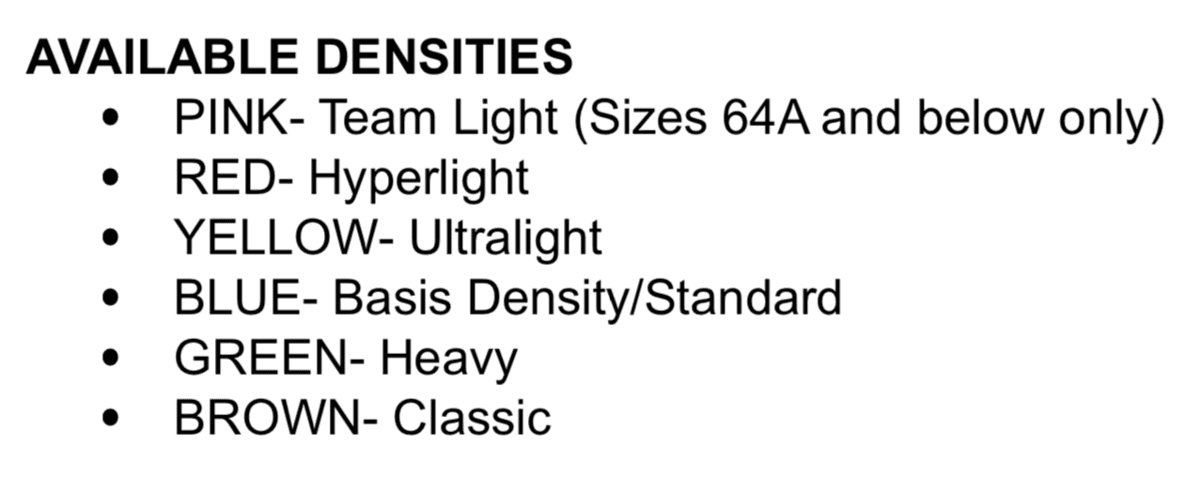
Millennium Foam is an alternative blank manufacturer that offers a broader range of densities at a typically lower price point than US Blanks or Arctic. Their density system uses colors similar to US Blanks but with different baseline positioning. Millennium's baseline is Blue (Basis Density / Standard).
Lighter than stock:
- Pink (Team Light) — Millennium's lightest foam. Only available on sizes 6'4" and below. Reserved for pro-level shortboards where maximum lightness matters.
- Red (Hyperlight) — lightweight shortboard density.
- Yellow (Ultralight) — higher strength-to-weight option for shortboards. Roughly equivalent to US Blanks Yellow CT.
Stock baseline:
- Blue (Basis Density / Standard) — the base density Millennium measures everything else against. Industry-standard shortboards, performance mids, step-ups.
Heavier than stock:
- Green (Heavy) — heavier density for performance logs, fun boards, and durable daily drivers.
- Brown (Classic) — Millennium's heaviest standard offering. Traditional longboards and glide-focused builds. Our default Millennium density for logs.
The Takeaway
Pick your manufacturer first (US Blanks if you're not sure — it's our default), then pick the density within that manufacturer's system. Don't try to translate densities across brands — the same color means different things at each supplier.
For the vast majority of customers, our defaults are dialed in: Yellow for shortboards / twins / smaller mids, Blue for everything in the middle, Brown (or Silver on Arctic) for logs. If you want something different — lighter because you're a small rider, heavier because you ride gutless waves, or anywhere in between — we'll walk you through it.